
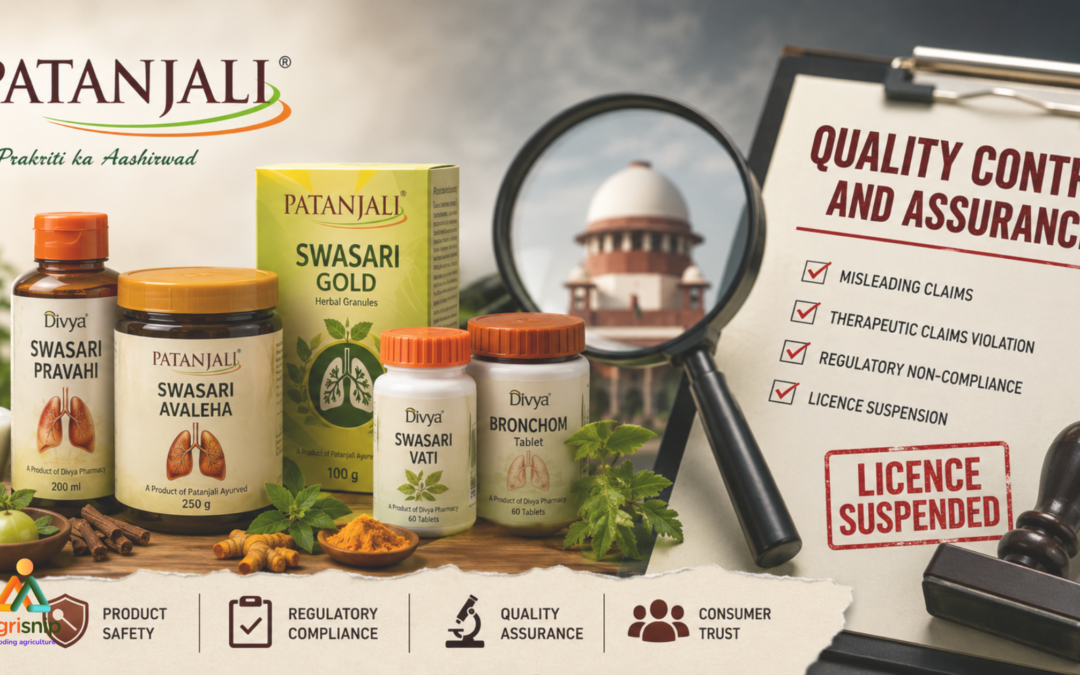
What happens when a brand built on trust faces questions about the very quality and credibility it promises to consumers? Patanjali’s journey offers a striking case study of how quality assurance extends far beyond manufacturing and laboratory testing. In 2024, regulatory action involving 14 Patanjali-linked products brought attention to misleading advertising, therapeutic claims and regulatory compliance.
The episode showed that quality failures can emerge not only from defective products, but also from weak processes, inadequate claim verification and gaps between marketing and regulatory controls. For consumer-health businesses, it raises one critical question: Is quality truly controlled across the entire product lifecycle?
Introduction
A strong consumer brand is built on more than product availability, aggressive marketing or customer loyalty. In sectors such as food, healthcare and Ayurveda, quality control (QC) and quality assurance (QA) are particularly important because consumers rely on manufacturers not only for product performance but also for safety, authenticity and truthful information.
Patanjali Ayurved became one of India’s most recognisable consumer brands by positioning Ayurveda and traditional wellness at the centre of its product portfolio. However, the company faced a major quality and compliance controversy in 2024 when the manufacturing licences of 14 products associated with Patanjali Ayurved and Divya Pharmacy were suspended by the Uttarakhand State Licensing Authority. Importantly, the regulatory action was linked to repeated violations concerning misleading advertisements and therapeutic claims, rather than a blanket finding that all 14 products were physically defective or unsafe.
This distinction is important for understanding the case from a quality management and assurance perspective. Quality is not limited to laboratory testing. It also includes regulatory compliance, validation of claims, documentation, traceability, process controls and ensuring that the final product reaches consumers with accurate information.
Background of the Patanjali Case
Patanjali Ayurved was established in 2006 and developed a large portfolio covering Ayurvedic medicines, food products, personal-care products and consumer goods. Its brand proposition was strongly connected with Ayurveda and natural wellness.
The controversy intensified when Patanjali and its promoters faced allegations concerning advertisements claiming that certain Ayurvedic products could provide cures or permanent solutions for diseases and medical conditions. The Supreme Court criticised the company’s advertising practices after Patanjali had previously given an undertaking that it would not make casual claims regarding medicinal efficacy or attack other systems of medicine.
In February 2024, the Supreme Court temporarily restrained Patanjali from advertising medicinal products for diseases covered under the Drugs and Magic Remedies (Objectionable Advertisements) Act. The proceedings subsequently became a significant regulatory and corporate-governance issue.
The 14-Product Regulatory Action
The most significant development came in April 2024.
The Uttarakhand State Licensing Authority suspended the manufacturing licences of 14 products manufactured by Divya Pharmacy and Patanjali Ayurved. The regulator stated that the action followed repeated violations of the Drugs and Magic Remedies (Objectionable Advertisements) Act.
Products named in reports included formulations such as Swasari Gold, Swasari Vati, Bronchom, Swasari Pravahi and Swasari Avaleha. These products were associated with claims concerning conditions including respiratory illnesses and other diseases.
The episode demonstrates an important principle of quality assurance: a product can face a quality-system failure even when the immediate regulatory problem is not a laboratory failure of the physical product itself.
In this case, the problem involved whether the organisation’s processes adequately controlled what claims were being made about regulated products.
Where Did the Quality Assurance System Fall Short?
1. Inadequate Control of Product Claims
A fundamental responsibility of a quality assurance system is to ensure that product information is accurate, scientifically supportable and compliant with applicable regulations.
When a medicinal product is promoted as capable of curing or permanently addressing a disease, the claim itself becomes a quality and compliance issue.
The Supreme Court noted that Patanjali had continued publishing advertisements despite an earlier undertaking concerning medicinal efficacy claims.
From a QA perspective, this suggests a weakness in the pre-publication review and approval process.
An effective system should have required:
Product development → scientific substantiation → regulatory review → legal review → marketing approval → controlled publication
If marketing material bypasses these controls, the organisation can create regulatory exposure even when manufacturing operations themselves are functioning.
2. Weak Regulatory Compliance Controls
Quality assurance is preventive. Its objective is to identify potential failures before they reach customers or regulators.
The Patanjali case raises questions about whether there were sufficient internal controls for monitoring regulatory commitments.
The Supreme Court had earlier been given an undertaking regarding advertisements, yet subsequent advertisements became part of the contempt proceedings. The Court later rejected an initial apology from Patanjali’s founder Baba Ramdev and managing director Acharya Balkrishna in the proceedings.
For a regulated organisation, this highlights the importance of a regulatory compliance management system with clearly assigned responsibility, approval workflows and audit trails.
3. Gap Between Quality Assurance and Marketing
One of the biggest lessons from the case is that QA cannot operate in isolation from marketing.
Marketing teams focus on differentiation, customer attention and sales. Quality and regulatory teams focus on safety, evidence and compliance.
These functions must work together.
For example, before making a health-related claim, a company should ask:
- Is the claim legally permitted?
- Is there adequate scientific evidence?
- Does the product’s approved indication support the claim?
- Has the regulatory team approved the communication?
- Is the wording consistent across packaging, advertisements, websites and social media?
- Is there documentation supporting the claim?
A failure at this interface can become a systemic quality problem.
Quality Control vs Quality Assurance in the Patanjali Case
The case is particularly useful for understanding the difference between QC and QA.
Quality Control focuses primarily on detecting defects. In a pharmaceutical or Ayurvedic manufacturing environment, this may include testing raw materials, monitoring manufacturing parameters, checking finished products and verifying specifications.
Quality Assurance, on the other hand, focuses on preventing failures through systems and processes.
The Patanjali controversy is therefore better understood primarily as a quality assurance and regulatory compliance case, rather than simply a case of defective products. The suspension of the 14 licences was connected to repeated misleading advertising violations, according to the Uttarakhand regulator. This distinction prevents an inaccurate conclusion that laboratory testing had established that all 14 products were defective.
Impact on the Company
The controversy created several layers of risk for Patanjali.
Regulatory Risk
The immediate consequence was the suspension of manufacturing licences for the 14 products. The Supreme Court also sought clarification regarding whether the products continued to be sold after the licence suspension. Patanjali’s counsel stated that sales had been stopped.
Reputation Risk
For a company whose competitive advantage is strongly connected with trust in Ayurveda and natural wellness, credibility is a strategic asset.
When regulators question product claims, consumers may begin questioning not only one advertisement but also the broader reliability of the brand.
Operational Risk
A licence suspension can disrupt manufacturing, inventory planning, distribution and retailer relationships.
It can also create uncertainty across the supply chain because distributors may need to identify affected products and ensure that restricted products are not being sold.
Governance Risk
The case also highlighted the importance of corporate governance. Senior management must ensure that regulatory commitments made to authorities are translated into operational controls throughout the organisation.
What Patanjali Could Have Done Differently
A stronger QA framework could have reduced the risk considerably.
1. Establish a Central Regulatory Review Committee : All medicinal product claims should pass through an independent regulatory and scientific review before publication.
2. Introduce Claim-Substantiation Files : Every therapeutic claim should have documented evidence supporting it. The evidence should be traceable to the exact wording used in marketing communication.
3. Strengthen Marketing Approval Controls : Advertisements should not be released merely because the marketing department approves them. Regulatory, legal and quality functions should have documented sign-off.
4. Conduct Regular Compliance Audits : Internal audits should examine newspapers, television advertisements, websites, social media and retailer communications to identify non-compliant claims.
5. Improve Corrective and Preventive Action : When a violation is identified, simply removing an advertisement is not enough. A proper CAPA system, or Corrective and Preventive Action system, should determine: What happened? → Why did it happen? → Which control failed? → How will recurrence be prevented?
6. Strengthen Traceability : If a product becomes subject to regulatory action, the organisation should be able to rapidly trace manufacturing batches, distributors, retailers and inventory locations.
This is especially important for large FMCG and healthcare supply chains.
Key Lessons for the FMCG and Healthcare Industry
The Patanjali case offers several lessons beyond one company.
- Quality is not only a laboratory function. It extends from raw materials and manufacturing to packaging, labelling, advertising and post-market monitoring.
- Regulatory compliance must be integrated into business processes rather than treated as paperwork.
- Marketing claims are part of product quality when they influence consumer expectations about safety or therapeutic effectiveness.
- Senior management must create a culture where compliance has authority over commercial pressure.
Finally, companies operating in health-related categories must understand that consumer trust can take years to build but can be damaged rapidly by regulatory controversies.
Conclusion
The Patanjali episode is a valuable case study in the difference between quality control and quality assurance. The 2024 suspension of licences for 14 products was not, based on the cited regulatory reporting, a finding that all those products were inherently defective.
Rather, it arose from repeated violations concerning misleading advertisements and product efficacy claims. That distinction makes the case even more relevant to quality management.
The central lesson is simple: quality must be designed into the entire product lifecycle, not inspected only at the end of manufacturing. For a large consumer-health company, an effective QA system should connect manufacturing, scientific evidence, regulatory compliance, marketing, documentation and post-market monitoring.
Patanjali’s experience demonstrates what can happen when these functions are not sufficiently integrated. In today’s competitive FMCG and healthcare markets, quality is not merely a technical requirement. It is a fundamental component of consumer trust, regulatory credibility and long-term business sustainability.