India’s agricultural economy does not end when a crop leaves the farm. In fact, that is where another complicated journey begins. Grains, edible oils, sugar, pulses and other commodities move through processors, wholesalers, distributors, institutions and retailers before reaching consumers.
Behind this movement lies a fragmented wholesale ecosystem where price discovery, procurement, logistics and working capital can become major challenges. This is the gap that Poshn set out to address.
Founded in 2020 by Shashank Singh and Bhuvnesh Gupta, Poshn started with a simple question: can technology make agricultural commodity trading more efficient?
What began as a digital procurement platform gradually evolved into a full-stack food supply-chain business serving food MSMEs and other buyers. Today, Poshn says it has crossed ₹1,219 crore in revenue, handled more than 21,000 orders and impacted over 2,000 MSMEs.
But Poshn’s journey was far from straightforward. Its founders had to change their original business model, convince traditional traders to adopt technology and build trust in an industry where relationships often matter as much as price.
The Problem Poshn Saw in India’s Food Trade
India has one of the world’s largest agricultural and food markets, but its supply chains can still be highly fragmented. A wholesale buyer looking for a particular commodity may have to deal with multiple suppliers, compare prices manually, coordinate transportation and manage payment terms.
On the other side, suppliers can struggle to find reliable buyers and predictable demand. Shashank Singh and Bhuvnesh Gupta encountered these challenges while working on agricultural and agritech projects.
Their experience led them to investigate the procurement problems faced by wholesale buyers. They found that buyers wanted better price discovery, reliable fulfilment and easier procurement, while suppliers needed distribution access and working capital. This became the foundation for Poshn.
Instead of trying to solve every agricultural problem at once, the founders focused on one specific part of the value chain: wholesale trade in processed agricultural commodities.
That focus was important. Agriculture is not one homogeneous market. The economics of wheat are different from those of edible oil, sugar or pulses. Geography, quality specifications, volumes, transportation and payment cycles all influence a transaction.
Poshn’s opportunity was therefore not simply to put agricultural products online. It was to make a traditionally relationship-driven wholesale market more organised and technology-enabled.
From a Digital Marketplace to a Full-Stack Platform
Poshn initially approached the market as a digital commerce and price-discovery platform. Buyers could communicate their requirements, while suppliers could compete to fulfil those requirements.
One of its early mechanisms involved reverse auctions. Buyers would post their requirements, and selected suppliers could respond with prices and delivery schedules. Poshn could then match the requirement with suitable suppliers.
The model addressed an important inefficiency: information. A buyer did not necessarily need to spend hours contacting multiple suppliers to understand the market. At the same time, suppliers received access to demand beyond their traditional networks.
But the company soon realised that price discovery alone was not enough.
A successful wholesale transaction also requires transportation, warehousing, quality coordination, payments and working capital. If the digital platform identified the best price but the product failed to arrive on time, the buyer still had a problem.
Poshn therefore expanded from being a discovery platform into an end-to-end fulfilment platform.
This shift changed the company’s role in the food ecosystem. Rather than merely connecting buyers and sellers, Poshn began integrating different parts of the transaction so that the trade could actually be completed.
The Founders Had to Learn the Hard Way
The Poshn story also contains an important lesson about startup building: the first business model is not always the right one. According to Forbes India, the founders initially struggled to raise funding and eventually ran into another challenge after gaining traction.
People were using the platform, but they were not necessarily willing to pay for it.That forced the founders to rethink their approach. Instead of remaining a simple marketplace, Poshn assumed greater control over demand and supply and rebuilt its model around actually facilitating transactions.
This was a critical turning point. For a startup operating in agriculture, adoption cannot be created simply by saying that a platform is digital. Traders need a tangible reason to change their existing behaviour.
If technology does not improve price, convenience, reliability, working capital or access to customers, there is little incentive to adopt it. Poshn’s eventual model focused on precisely those practical benefits.
The experience demonstrates why agritech businesses often need a different approach from conventional consumer internet startups. Agriculture has established networks, physical products, unpredictable supply conditions and multiple intermediaries. Technology has to work alongside those realities rather than trying to eliminate them overnight.
How Poshn’s Business Model Works
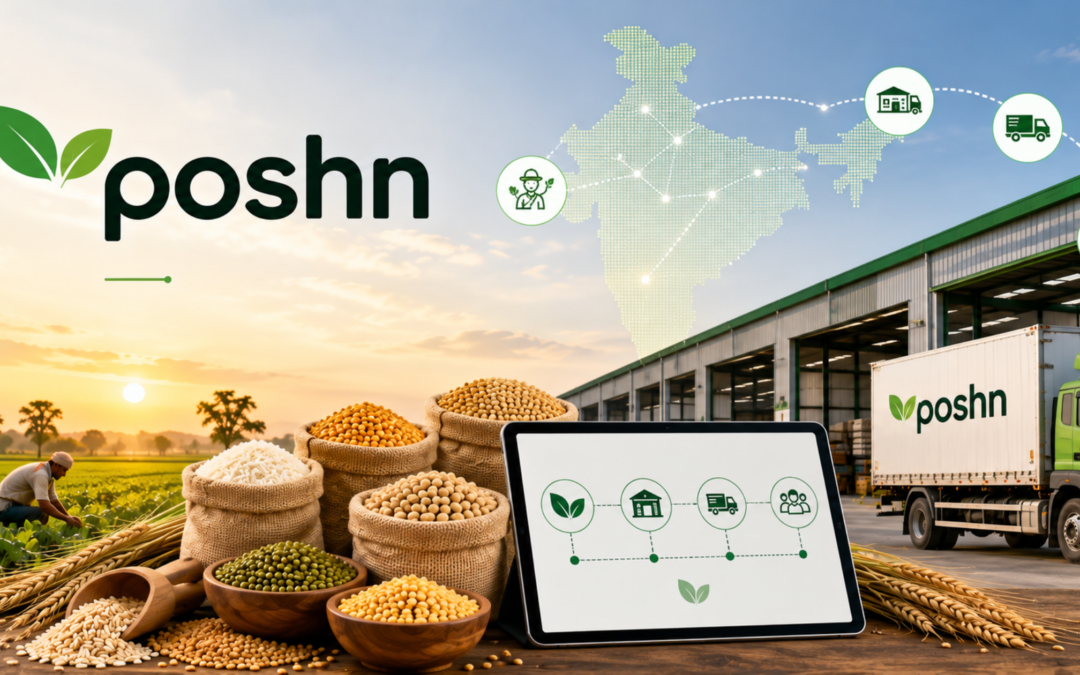
Poshn describes itself as a platform simplifying the food ecosystem, particularly for MSMEs involved in food trading and distribution. Its current approach combines several services instead of depending on one marketplace function.
At the centre is demand aggregation. Instead of treating every buyer independently, Poshn can aggregate demand from different channels and use that information to improve procurement.
The company also provides access to suppliers and distribution networks. This helps businesses source commodities without depending entirely on their existing supplier relationships.
Another important component is embedded finance. Food businesses frequently require working capital because there can be a time gap between purchasing inventory and receiving payment from customers.
Poshn has worked with banks and NBFCs including ICICI Bank, Alteria Capital, UCIC, Northern Arc, BlackSoil and Capsave to address financing requirements. Logistics and warehousing partnerships add another layer.
This creates a model where procurement, financing, fulfilment and technology work together. Poshn’s website now describes its offering as a full-stack SaaS solution called Nucleus, aimed at trade and distribution. The company reports more than 1,000 SKUs, 274,000+ metric tonnes of traded volume and more than 2,000 MSMEs impacted.
Why MSMEs Are Central to the Poshn Story
India’s food economy is heavily dependent on small and medium-sized businesses. They participate in processing, wholesale distribution, retail and regional trade, but many operate with limited access to technology and organised supply-chain infrastructure.
For these businesses, procurement is not simply about finding the lowest price. They need consistent quality, predictable delivery, manageable payment terms and access to sufficient inventory. A disruption in any one of these areas can affect their entire operation.
Poshn’s model attempts to bring these requirements together. Its focus on MSMEs is therefore strategically important. Instead of competing directly for consumers, the company operates deeper within the food value chain.
This B2B approach also creates a different growth equation. Each transaction can involve significant commodity volumes, and a platform that builds trust with repeat business customers can potentially generate substantial transaction value.
Poshn says it has expanded its distribution coverage and has become a major player in categories such as sugar and edible oils in Delhi-NCR. The broader ambition is to create a more connected ecosystem where businesses can procure and distribute food commodities with less friction.
Technology Is the Engine Behind the Model
Technology is important to Poshn because the company is dealing with thousands of individual requirements, suppliers, commodities, prices and delivery conditions.
The company has described using proprietary technology and AI-based matching to break buyer requirements into smaller segments and identify suitable suppliers. Agriculture Today reported that this approach was designed to reduce the time required to complete trades. This is particularly relevant in commodity markets.
Prices can change quickly. Transportation costs vary by location. Different buyers have different quality and volume requirements. A manual system can become slow when the number of transactions increases. Technology can help create a structured data layer across these transactions.
The long-term advantage, therefore, may not simply be the marketplace itself. It could be the information Poshn accumulates about demand, supply, pricing, fulfilment and purchasing behaviour.
That data can potentially help the company make better procurement decisions, improve supplier matching and develop additional financial or software products. In this sense, Poshn is trying to build more than an online commodity marketplace. It is attempting to create digital infrastructure for food trade.
The Funding That Accelerated Its Expansion
Investors have also recognised the potential in Poshn’s model.In 2022, Poshn raised around $4 million in equity in a seed round led by Prime Venture Partners and Zephyr Peacock India.
In May 2024, the company announced another $6 million pre-Series A round, comprising $4 million in equity and $2 million in debt. Prime Venture Partners and Zephyr Peacock India again led the round.
The fresh capital was intended to help Poshn build its technology and solution stack, expand its supply-chain operations and explore international import and export opportunities, particularly in Southeast Asian and Middle Eastern markets. This funding was significant because Poshn was not simply raising money to acquire consumers.
Its capital requirements are connected to the complexity of B2B food trade, including technology, working capital, distribution and expansion.
The company’s funding journey also illustrates an important trend in agritech. Investors are increasingly interested in startups that solve specific supply-chain inefficiencies and can demonstrate strong commercial activity rather than relying solely on large user numbers.
From ₹0 to Hundreds of Crores
Poshn’s growth has been particularly notable in terms of business scale. The company says its journey went from zero to ₹510 crore in three years, while its current website reports revenue of ₹1,219 crore.
Independent reporting also indicates that Poshn generated more than ₹900 crore in FY2025. An Agritech-focused report from Entrackr placed its FY25 revenue at approximately ₹923 crore and highlighted Poshn as one of the more capital-efficient funded agritech companies crossing ₹100 crore in revenue.
These numbers matter because agritech has historically faced a difficult challenge: building large businesses in an industry with relatively thin margins and complicated physical operations. Poshn’s model attempts to address that challenge through transaction volume, technology and an asset-light approach.
Instead of owning every part of the physical supply chain, the company can work with existing suppliers, logistics providers and infrastructure while providing the technology and coordination layer. That can allow the business to scale without having to build an enormous physical network from scratch.
Taking Indian Food Trade Beyond India
Poshn’s ambitions are not limited to the domestic market. After its 2024 funding round, the company said it wanted to explore global opportunities in profitable import and export categories, particularly across Southeast Asia and the Middle East.
This makes strategic sense for a company operating in agricultural commodities. India is both a major producer and consumer of food commodities, while international trade creates opportunities for businesses that can manage sourcing, processing, distribution and financing.
However, international expansion also brings new challenges. Commodity standards, documentation, currency movements, trade policies, logistics costs and international quality requirements can complicate transactions.
Poshn’s ability to integrate technology, procurement and financing could become important if it successfully expands into these markets. The bigger opportunity is to connect fragmented participants not just within India, but across international food supply chains.
What Makes Poshn Different from a Traditional Agribusiness?
Traditional agricultural trade depends heavily on relationships. A trader may know which supplier provides consistent quality. A processor may have long-standing arrangements with distributors. A wholesaler may depend on personal networks to discover prices.
Poshn is not necessarily trying to replace these relationships. Instead, its model attempts to make the underlying processes more efficient through technology.
That distinction is important. The company’s opportunity lies in reducing friction while retaining the practical realities of physical commodity trading. Buyers still need products to arrive at the right place and time. Suppliers still need reliable payments. Logistics providers still need cargo to move.
Technology becomes the connecting layer. This approach is also why Poshn’s evolution from marketplace to full-stack supply-chain platform is significant. The company learned that solving one part of the transaction was insufficient. To create lasting value, it needed to address multiple bottlenecks together.
The Road Ahead for Poshn
Poshn is entering a phase where scale will bring both opportunities and challenges. Its current focus on food MSMEs, commodity distribution and technology gives it access to a large market. Its reported scale across orders, SKUs, traded volume and MSMEs indicates that the company has moved beyond the experimentation stage.
The next challenge will be maintaining growth while protecting margins and operational efficiency. Commodity businesses can face volatile prices, working-capital pressure and logistics disruptions. Expansion across more products and geographies can increase complexity.
At the same time, the opportunity is substantial. If Poshn can successfully combine demand aggregation, procurement, embedded finance, logistics and software, it could become an important infrastructure layer for India’s food economy.
Its story also demonstrates that agritech does not have to mean only farm-level technology. Some of the biggest inefficiencies exist after production, in the movement of commodities between businesses.
Read more agribusiness stories here : https://agrisnip.com/startoscope/
Conclusion: Poshn’s Bigger Lesson for Agribusiness
Poshn’s journey began with a simple observation: agricultural wholesale trade was too fragmented and inefficient. The founders, Shashank Singh and Bhuvnesh Gupta, initially tried to solve the problem through digital procurement and price discovery.
When that model struggled to monetise, they changed course. They moved towards controlling the transaction and eventually built a broader supply-chain platform connecting procurement, distribution, financing, logistics and technology.
That evolution is perhaps the most interesting part of the Poshn story. The company did not succeed simply because it put agriculture online. It identified a real commercial problem, tested a solution, listened to the market and changed its model when the first approach did not work.
Today, Poshn is positioning itself as a technology-driven platform for the food ecosystem, with ambitions extending from Indian wholesale markets to global trade.
Its journey offers a broader lesson for Indian agribusiness: the next big opportunity may not only be in growing more food, but in making the journey from producer to business more efficient. And that is the space Poshn is trying to transform.