
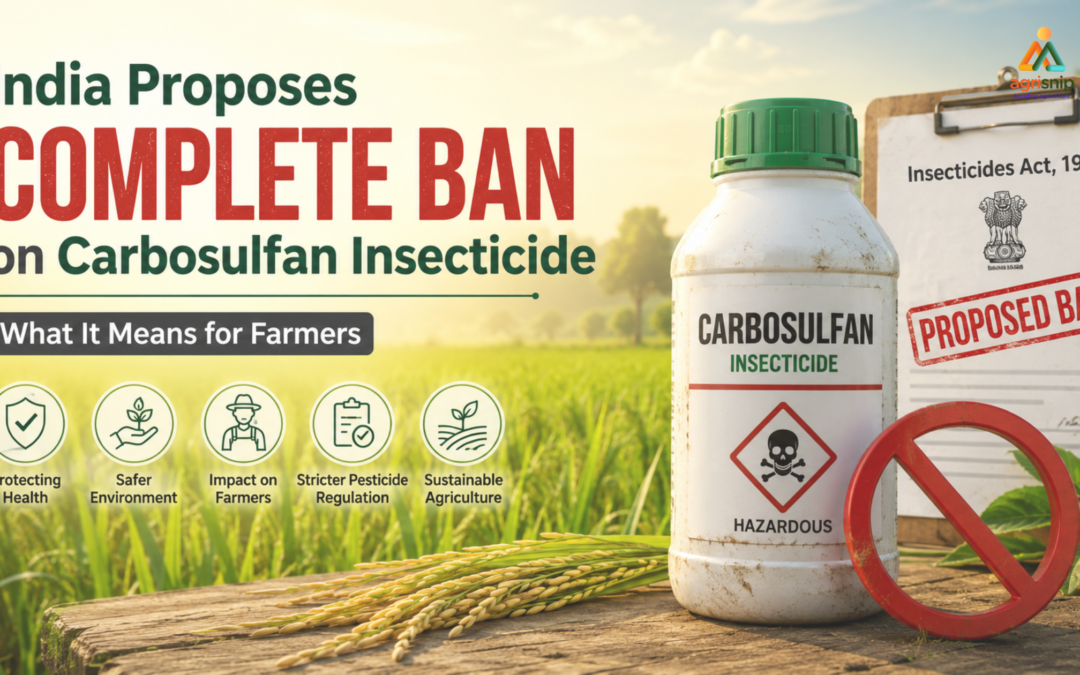
What happens when a widely used insecticide suddenly comes under a proposed nationwide ban? India’s move against Carbosulfan could reshape pest management across paddy, cotton and horticultural crops. For farmers, manufacturers and the agricultural sector, the decision raises one crucial question: what comes next for affordable and effective crop protection?
India has taken another significant step toward tighter regulation of hazardous agricultural chemicals. The Centre has proposed a complete prohibition on Carbosulfan insecticide, citing concerns over human health, animal safety and environmental damage.
The proposal comes after an expert review and subsequent examination by the Registration Committee under the Insecticides Act, 1968. However, farmers and agrochemical companies should note that the proposal is not yet a final ban. The government has invited objections and suggestions before taking the final decision.
Why Has the Government Proposed a Ban on Carbosulfan?
The proposed action follows a review initiated by the Ministry of Agriculture and Farmers Welfare. An Expert Committee was constituted on 14 January 2026 to assess whether the continued use of Carbosulfan should be allowed. Its report was submitted to the Centre on 12 June 2026.
The Registration Committee subsequently examined the findings, available safety data and recommended studies before recommending a complete prohibition. The committee classified Carbosulfan as an intrinsically highly hazardous carbamate insecticide.
One of the major concerns is its conversion into Carbofuran, a highly toxic metabolite associated with severe cholinesterase inhibition and acute systemic toxicity. The review also raised concerns about exposure risks to birds, pollinators, aquatic organisms and other non-target species.
What Will the Proposed Carbosulfan Ban Cover?
The proposed Banning of Carbosulfan Order, 2026 is broad. If finalised, it would prohibit the manufacture, import, sale, transportation, distribution and use of the insecticide across India.
Existing registration certificates would also be withdrawn. Certificate holders would reportedly have three months to return their registrations, while the certificates would be treated as cancelled under the proposed order. State governments would then be responsible for implementing the prohibition within their jurisdictions.
This means the proposal could affect the entire supply chain rather than simply restricting how farmers use the chemical.
What Could It Mean for Farmers and Agriculture?
Carbosulfan has been used in several crop systems, including paddy, cotton and horticultural crops. A complete prohibition could therefore require farmers to shift toward alternative pest-control products and integrated pest-management practices.
For farmers, the transition will be important. If suitable alternatives are not readily available, affordable and effective, pest-management costs could increase or farmers could face difficulties controlling particular pests.
The agrochemical industry may also need to adjust product portfolios and supply chains. Industry concerns have already focused on the possibility of a pest-control gap following the proposed withdrawal.
Ban Is Proposed, Not Yet Final
The most important point is that Carbosulfan has not been finally banned yet. The government has published a draft order and opened a 30-day window for objections and suggestions. The final decision will follow consideration of stakeholder responses and the completion of the regulatory process.
The proposal reflects India’s growing focus on balancing agricultural productivity with food safety, occupational health and environmental protection. For farmers, manufacturers and retailers, the next stage will be crucial as the government determines how the proposed insecticide prohibition will be implemented.
Read more news about the agricultural policies here : https://agrisnip.com/agri-news/
Conclusion
India’s proposed ban on Carbosulfan insecticide signals a stronger shift toward safer and more sustainable crop protection. While the government’s concerns over human health, animal safety and environmental risks are significant, the proposal is still subject to stakeholder objections and suggestions before a final decision is taken.
For farmers, the priority will be ensuring access to effective and affordable alternatives without creating new pest-control challenges. Agrochemical companies may also need to rethink product portfolios and supply chains if the prohibition is finalised.
Ultimately, the proposed Carbosulfan ban highlights the growing need to balance agricultural productivity with food safety, farmer welfare and environmental protection. The final regulatory decision will determine how India’s crop-protection sector adapts to this changing landscape.
