
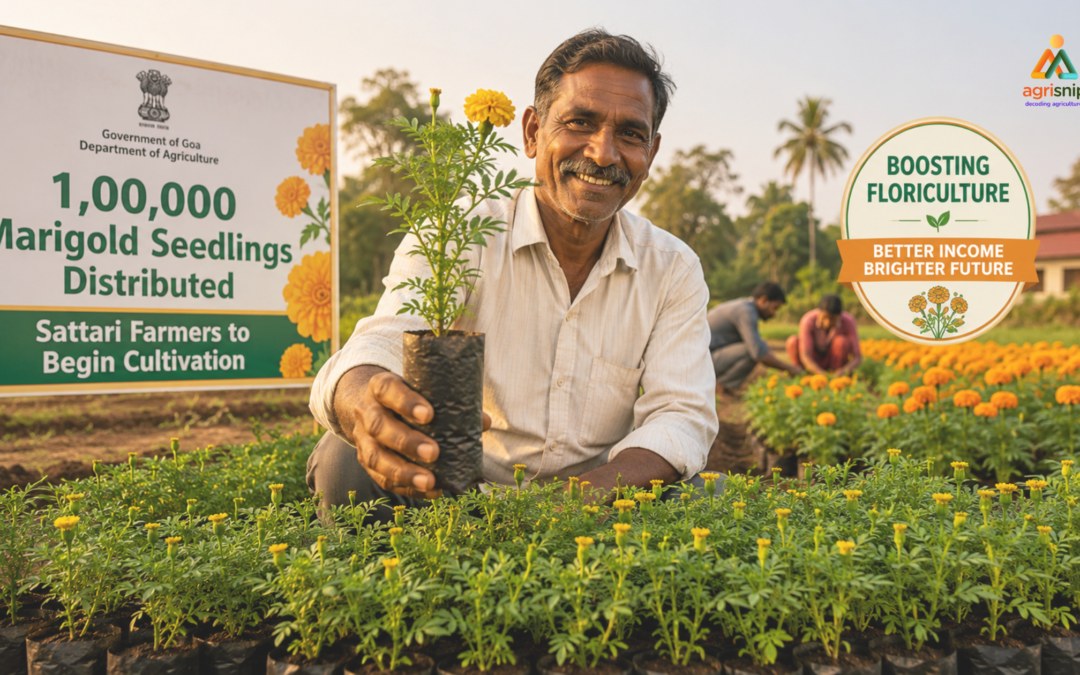
What if a flower that fills Goa’s temples, festivals and celebrations could also become a new source of income for farmers? The Agriculture Department is turning this possibility into action by distributing one lakh marigold seedlings to farmers in Sattari. The initiative aims to encourage floriculture, strengthen local flower production and help farmers tap into rising seasonal demand.
As Goa looks to reduce its dependence on flowers sourced from outside the state, marigold cultivation could offer farmers a practical opportunity to diversify their crops and build an additional income stream. Goa has begun a fresh push toward commercial floriculture by distributing one lakh marigold seedlings to farmers in the Sattari region.
The Agriculture Department expects the initiative to create a new income stream while reducing the state’s dependence on flowers imported from neighbouring states.
Floriculture becomes a diversification strategy
The seedling distribution is more than a seasonal programme. It is part of Goa’s broader effort to diversify agriculture with high-value crops that fit small and medium farms. Marigold is widely used for festivals, temples, weddings, and decoration, giving growers a relatively dependable local market.
The department has paired the distribution drive with technical guidance so first-time flower growers can establish healthy crops and improve survival rates. Officials also see the programme as a step toward strengthening rural livelihoods through value-added horticulture rather than relying only on traditional crops.
If cultivation expands successfully, local production could gradually replace a significant share of imported flowers and keep more of the festival economy within the state.
Farmers and markets stand to benefit
For Sattari farmers, the timing is important because marigold demand rises sharply during major religious and cultural celebrations. A successful harvest can therefore generate faster returns than many longer-duration crops.
Beyond individual income, wider cultivation can support local nurseries, transporters, and flower traders, creating a broader rural value chain. Marigold also fits well into diversified farming systems because it requires relatively modest investment and has a short crop cycle, allowing farmers to plan multiple crops across the year.
Goa has already set a target of becoming self-sufficient in marigold production within two years, and expanding cultivation in new areas is central to that ambition. The current distribution drive is expected to build confidence among growers while creating the production base needed for that longer-term goal.
A model for value-added horticulture
The Sattari initiative shows how targeted government support can encourage farmers to adopt commercially attractive crops without abandoning food production. By supplying quality seedlings at the start of the season, the Agriculture Department reduces one of the biggest barriers for first-time growers and gives them a better chance of establishing uniform fields.
The programme also reflects a shift from input support alone to market-oriented planning, where crop choice is linked to predictable demand from festivals and local commerce. If farmers receive continued extension support and reliable market access, marigold cultivation could become a profitable supplementary enterprise for many households.
Success in Sattari may encourage similar floriculture programmes in other parts of Goa, strengthening local supply chains and reducing dependence on imports during peak festive seasons.
Read the latest agri news here https://agrisnip.com/agri-news/
Conclusion
The distribution of one lakh marigold seedlings in Sattari marks an important step toward expanding floriculture in Goa. By encouraging farmers to cultivate marigold, the Agriculture Department is aiming to improve farm incomes, meet local demand and reduce dependence on flowers brought in from other states.
If farmers receive continued technical guidance and reliable market support, the initiative could develop into a sustainable source of rural income. Its success may also encourage wider adoption of commercial flower cultivation across Goa.
