

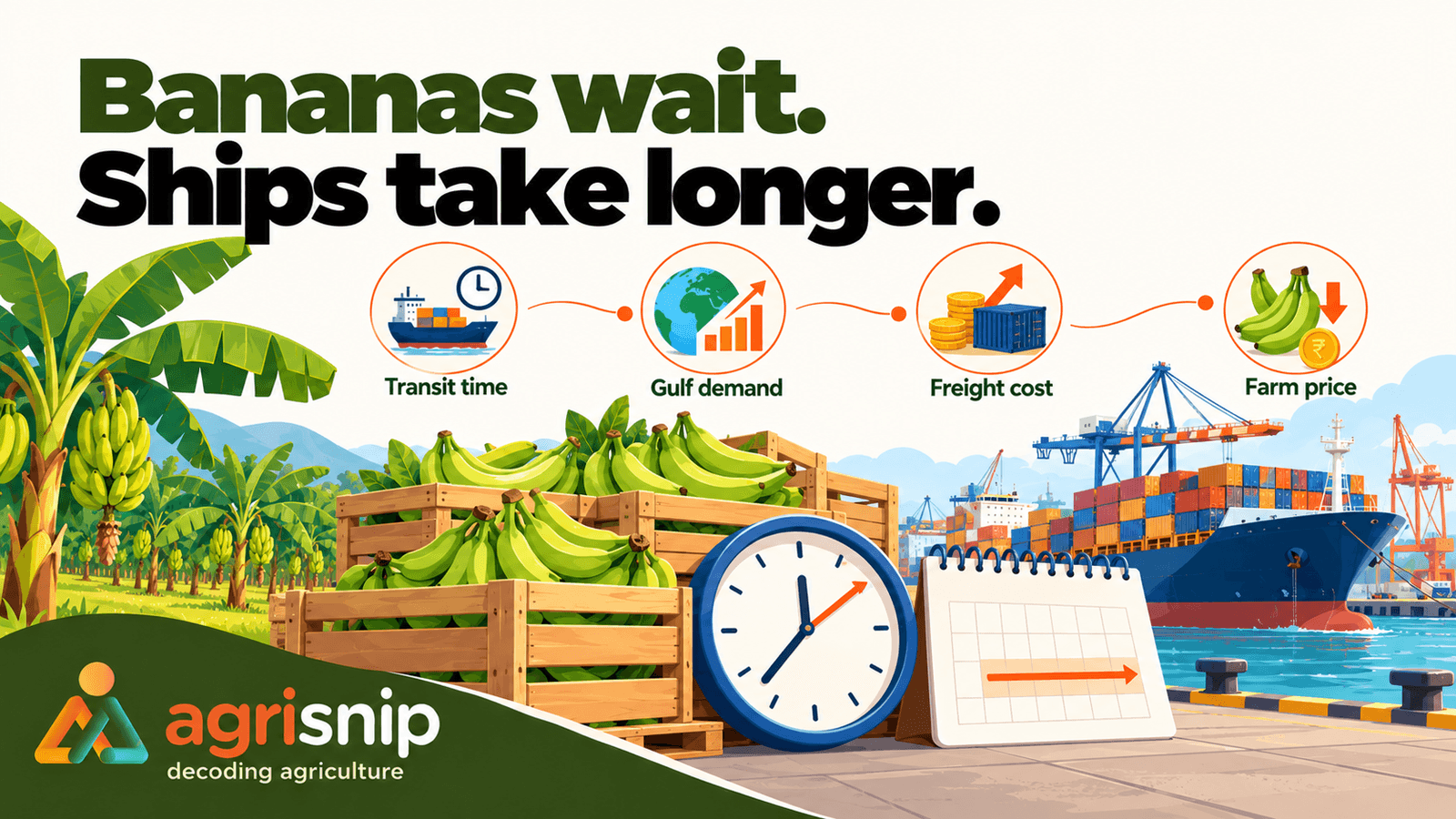
Indian banana exports to the Middle East are down by more than 65% on last year, according to Shyam Dhumal of exporter Agroindi Exim Pvt. Ltd. Across West and Central Asia, he puts the fall at around 80%. Slow sea routes and higher freight costs are the main reason.
That hurts in a year when the trade had been growing fast. Banana exports were worth about $462 million (₹4,368.75 crore) in 2025-26, up 36% from ₹3,209.92 crore a year earlier. Even so, exports remain a small share of what India grows.
October is normally one of the busiest months. Demand builds before winter, when chilling injury becomes a worry for bananas. Iran also starts buying more from mid-October, when its apple season begins.
What Has Changed on the Water
A banana does not wait. A shipment from India to the UAE used to take five to seven days. Dhumal now puts the voyage at 17 to 25 days, and a September report by India Seatrade News said it can pass 30 days to Jebel Ali. Exporters blame the conflict and disruption around the Strait of Hormuz.
Longer voyages mean higher freight bills and less shelf life when the fruit lands. Delays and uncertain ship schedules make it harder for exporters to keep quality up and quote a fair landed price to buyers.
Barter is under strain too. Some Indian exporters swap bananas for apples, dates and kiwis from buyers in the region, and Dhumal says those deals are now harder to run.
Why Prices at Home Are Under Pressure
Fruit grown for export does not vanish when a ship is late. It heads to the home market instead. Dhumal says that extra supply is weighing on domestic prices and on farmers' returns.
He puts current domestic prices at ₹13–17 a kg. Export-grade fruit, he says, is fetching ₹18–22 a kg and has stayed fairly steady in recent months. The gap between the two is the size of the risk for a grower: fruit that misses the ship earns less.
Who Is Exposed
Growers in Maharashtra and Madhya Pradesh, who have leaned most on Gulf buyers, are the most exposed, according to India Seatrade News.
Supply may tighten as well. Lower rainfall in Maharashtra and Andhra Pradesh could limit the next crop, and Dhumal says exporters are already working harder to find fruit that meets buyers' needs on size, maturity, appearance and shelf life. Unseasonal summer rain damaged some crops. Fruit from areas that escaped the damage has done well.
How Exporters Are Responding
Exporters are looking beyond the Gulf. India Seatrade News reports trial shipments to Russia, and buying from more states: Andhra Pradesh, Madhya Pradesh, Gujarat, Tamil Nadu and Karnataka.
New markets take time to build, though, and they will not replace lost Gulf volumes straight away. The same squeeze is visible in other fruit. Read how Japan's ban and high freight costs hit Indian mango exports.
What It Means for Farmers
A late ship is not only an exporter's problem. If a consignment is held up, rejected or lands with weak shelf life, the loss can travel back to the farm gate. Fruit that misses export grade has to be sold at home, where the price is lower and supply is already heavy.
Growers who sell through an exporter or a Farmer-Producer Organisation should know who pays when a shipment is delayed. Growers who sell on their own are selling into a home market that the extra fruit is already pressing down.
What Farmers Can Do Now
No rule has changed, so there is nothing to file. But a few checks are worth making before the next harvest. Ask your buyer in writing which route the fruit will take and what happens to your price if the ship is late. Stick to the buyer's size, maturity and appearance needs, since export-grade fruit is the part of the market that has held its price. Ask what the plan is for fruit that misses the shipment. If you are unsure where to start, your district horticulture office can point you to APEDA-approved packhouses.
Conclusion
Gulf demand has not gone away. The shipping has. India's banana trade has lost its old edge of short delivery times, and growers are carrying part of the cost. Watch two things in the coming weeks: how much export-grade fruit is left after this year's weather, and whether voyages to the UAE come back down from 17–25 days.