

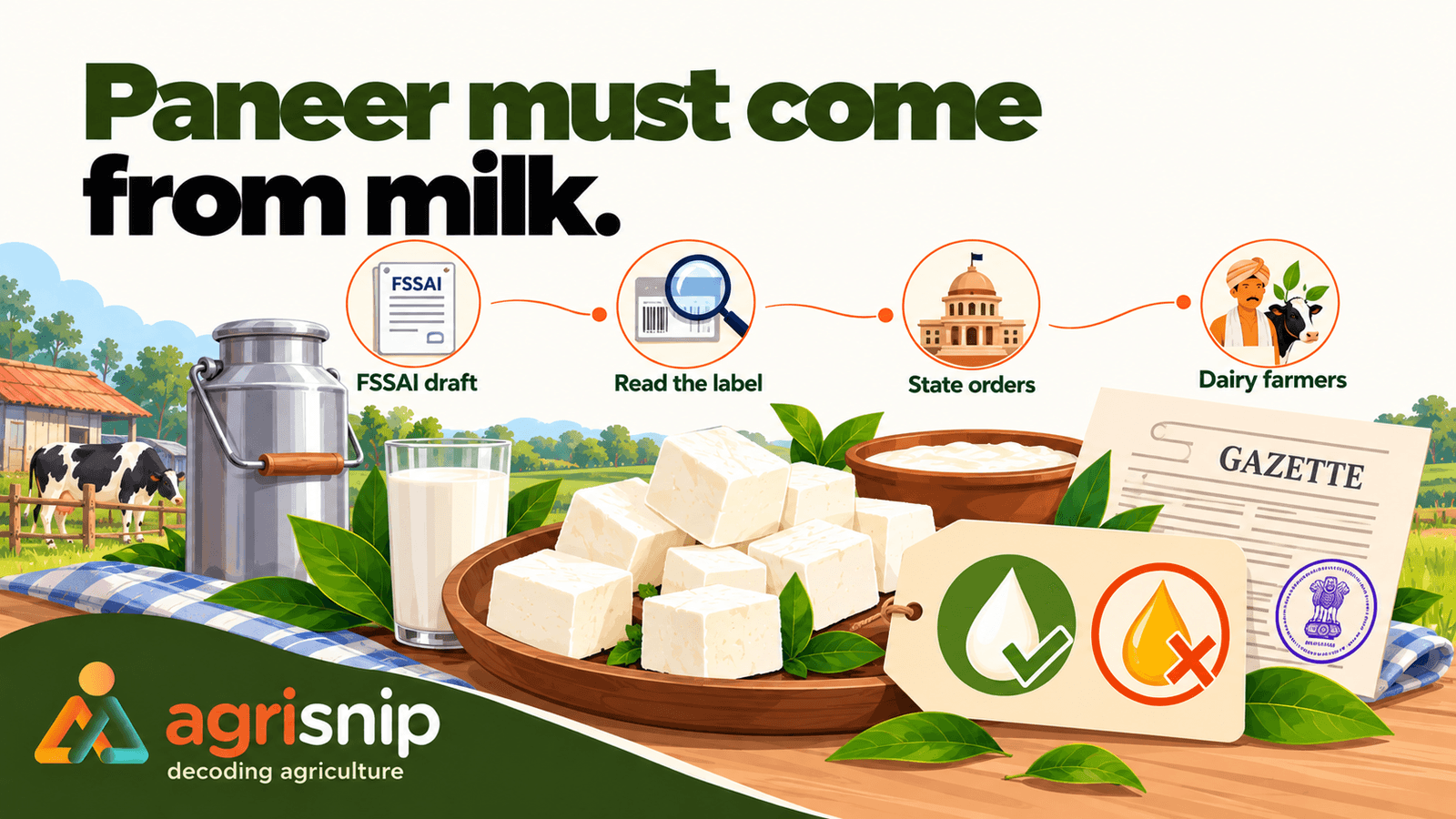
If you have ever wondered whether the paneer on your plate came from milk, a new draft from the food regulator speaks to exactly that. The Food Safety and Standards Authority of India (FSSAI) has proposed that only products made from milk can be sold under the name "paneer". Look-alikes built on vegetable oil, starch and emulsifiers would have to find another name.
Right now it is a draft, not a final law, and the public comment period is still running. Several states have already moved on their own, and festive-season raids in Delhi have shown why the issue is so heated. This explainer sets out what the draft says, what we do not yet know, and what buyers, restaurants and dairy farmers can do in the meantime.
What the Draft Actually Says
The notification is dated 22 September 2026 and was published in the Gazette the next day, according to Business Today. It is a draft amendment to the Food Safety and Standards (Prohibition and Restrictions on Sales) Regulations, 2011, issued with the Central Government's prior approval. The 2011 rules were last amended on 23 May 2026.
Its core is a new clause under Regulation 2.1.1. The South First, which reported that FSSAI's chief executive signed the notice, quotes the new clause as "(12) paneer made from milk". Products already licensed or registered in the category called "Analogue in Dairy Context" would have to stop using the word paneer in their name, labels and marketing.
The stated aim is simple: stop shoppers from being misled about what is in the pack. Analogue paneer looks and cuts like paneer, but ingredient lists typically show vegetable oils, starches and emulsifiers where milk solids would be. Selling such a product is not the same as adulteration. Under the draft, an honest product can stay on the market, as long as the label does not borrow the paneer name.
Where the Process Stands
Draft rules go through a public comment window before they harden into law. Objections and suggestions will be considered after 60 days from the date the Gazette copies are made available to the public. The notices reported so far do not give a calendar closing date, so the exact deadline is not confirmed here. If you plan to send comments, check the FSSAI website for the notice itself.
Until the rule is final, nothing changes nationally. Analogue paneer can still be sold with the right label under existing norms.
The States Got There First
State governments did not wait for Delhi. Karnataka's notification of 17 August bars analogue paneer from being sold as paneer for one year. Telangana's order took effect on 10 September 2026, also for a year, under Section 30(2)(a) of the Food Safety and Standards Act, 2006.
Madhya Pradesh announced an immediate statewide ban on the manufacture, distribution and sale of analogue paneer in mid-August, as republished by Dairy News. That report calls it the fourth state with a broad prohibition, after Maharashtra, Gujarat and Chhattisgarh, and lists raids on factories, seizures and new testing as the enforcement tools. It names no fines.
Maharashtra had gone another way earlier in the year: restaurants there were told to disclose when a dish uses a paneer substitute, from 1 May 2026. Reports from Nagpur in May said many eateries were ignoring the rule. A patchwork like this is one reason FSSAI's national draft matters. A single definition would replace a handful of local ones.
Why Dairy Groups Want It
The price gap explains everything. In March 2025, a Maharashtra dairy association put analogue paneer's production cost at about Rs 110 a kilogram and its selling price at Rs 150-160. For milk paneer it quoted roughly Rs 280 to make and Rs 325 or more to sell. Those are the association's own figures and are over a year old, so treat them as an indication of the gap, not a current price list.
The same group said more than half of institutional buyers, such as hotels and restaurants, had already switched to analogue paneer because it is cheaper. For a dairy that sells milk or paneer to caterers, that is lost demand. Madhya Pradesh officials used similar reasoning, saying cheap substitutes pull sales away from liquid milk and from the cooperatives that buy from smallholders.
Consumer health is the other argument. The Maharashtra group points to heavy vegetable oil intake. Analogue products are not banned as unsafe in the draft, though, and no source reviewed here gives test data showing that properly made analogue paneer harms health. The real problem is labelling: a buyer who thinks she is paying for milk protein gets oil and starch.
The Delhi Raids: Adulterated Is Not the Same as Analogue
Delhi's festive season drive added fuel. The magazine reports that authorities seized over 4,100 kg of non-compliant khoya, chhena and analogue paneer in a month. Of 30 samples from the Mori Gate khoya market, 22 were reportedly unsafe, and 12 of 19 khoya and chhena samples failed standards. Those numbers are attributed to the Delhi Chief Minister's Office.
Read those numbers carefully. Failing a test for khoya means the sweet base did not meet its standard. It says nothing, by itself, about analogue paneer, which is a different product. Mixing the two ideas is how rumours start. The draft is about names on labels. Adulteration, meaning passing off one thing as another or adding harmful substances, is already an offence under the 2006 Act.
FSSAI has also acted against online platforms, including Amazon, Swiggy Instamart, BigBasket, Flipkart India and Zepto, over misleading claims and restricted products, the magazine says.
A Separate Rule on Moving Perishables
A related FSSAI circular, noted on the same pages, covers the storage and transport of khoa, paneer, meat and fish. It calls for clean, covered vehicles, temperature control, food-grade packaging with no gunny bags, and records that allow a product to be traced. Non-compliant loads can be seized and destroyed.
For a small dairy or a paneer trader, this one affects the business sooner than the name change. Check your vehicle, packaging and paperwork now, before an inspector does.
What Buyers Can Do Today
Read the ingredient list first. Real paneer shows milk, and little else beyond a souring agent. Vegetable oil, starch or "milk solids and edible oil" in the list tells you it is an analogue. Be wary of paneer priced far below the going rate in your town. Loose paneer is the hardest to judge, so buy it from an outlet you trust. If you suspect a product, report it to your state food safety officer.
Restaurants and caterers should ask suppliers for the licence category and the label. Dairy farmers and producer groups can use the moment to promote their own paneer with a clear milk-based claim.
Questions Readers Ask
Is analogue paneer banned across India? No. The national proposal is still a draft. Karnataka, Telangana, Madhya Pradesh and some other states have their own orders.
Does the draft ban analogue products? No. It stops them from using the word paneer. They would need a different name.
Is analogue paneer unsafe? The draft does not say so. It treats the issue as one of honest labelling.
When will the rule take effect? Not before the comment period ends and FSSAI issues a final notification. No date is announced.
Conclusion
Paneer is a staple, and a name matters when it is the main thing a buyer has to go on. The FSSAI draft tries to settle that question in a single line: if it says paneer, it comes from milk. Watch for three things. The close of the comment window will show how much pushback the industry offers. The final notification will say whether existing stock gets a grace period. And the states' one-year orders in Karnataka and Telangana will come up for review in 2027, which will show whether local bans give way to the national rule. Until then, the label is your best guide.