

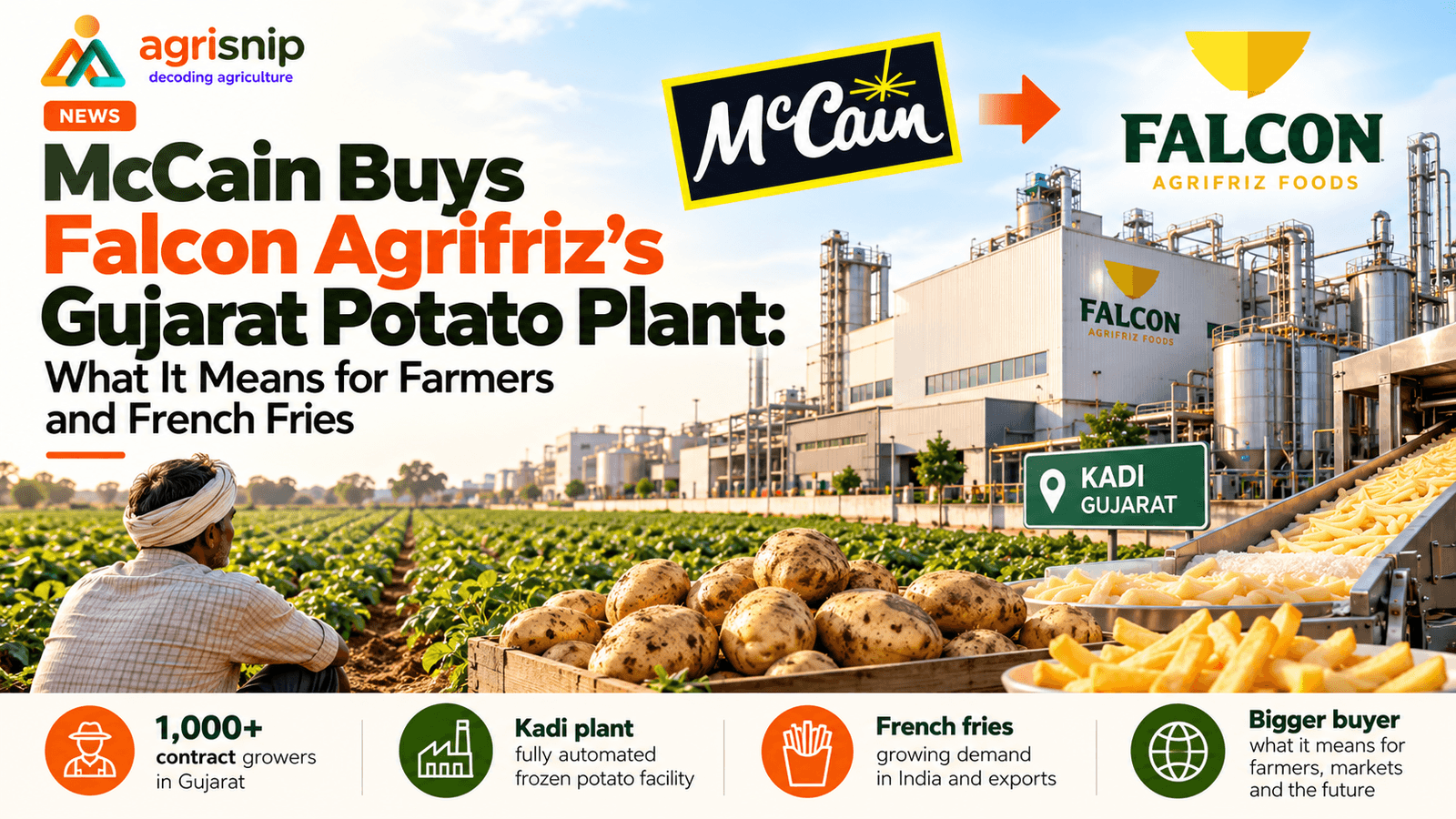
Two of India's biggest frozen-fries makers are about to become one. On 12 October 2026, McCain Foods announced that it has agreed to buy the frozen potato business of Falcon Agrifriz Foods in Gujarat. Both companies already work in the Mehsana district, the state's potato-processing belt.
For most readers this is a business headline. For a potato farmer in north Gujarat it is something closer to home, because the buyer of your crop may be changing. This explainer sets out what is known about the deal, what has not been disclosed, and the questions growers should be asking before the next planting season.
What Has Been Announced
McCain will take over Falcon's fully automated plant at Kadi, the staff who run it, and the contract-farming relationships behind it. Falcon says it has more than 450 employees and works with over 1,000 farmers across Gujarat. The deal still needs to clear customary closing conditions, and the price has not been made public.
Falcon built the plant fast. Its vice chairman, Parthajeet Patnaik, said the site was set up and commissioned in under two years. An earlier trade report on the May 2025 inauguration described a French fries line rated at 15 tonnes an hour, a second line for speciality potato products at 3.5 tonnes an hour, and a 25-acre site, tied to a ₹1,050 crore investment agreement with the Gujarat government. That report also said Falcon worked with more than 4,000 contract farmers, which is far above today's figure of 1,000. The two numbers are not explained in any source, so read them as a question, not a fact.
McCain is no newcomer. It entered India in 1998, now employs more than 940 people directly and works with over 2,500 growers. Its Indian range stretches from fries to aloo tikki, vegetable fingers and cheese bites. Weeks before the Falcon news, it had finished a C$135 million expansion at Mehsana, reported at roughly ₹918 crore, that added 110 full-time and 150 contract jobs.
Why Now: Fries Are Moving From Treat to Staple
India exported about 277,109 tonnes of frozen French fries in 2025-26, going by the industry data cited in the magazine. That figure is a reminder that a vegetable most Indians eat boiled or fried at home has become an export line.
Domestic appetite is growing too. Quick-service restaurants, hotels and caterers buy fries by the tonne, and retail packs have moved from metro stores to smaller towns. HyFun Foods, another large Gujarat processor, makes about three-quarters of its revenue from exports, according to Reuters reporting carried in Open Magazine. HyFun expects that share to fall towards half within five years as home demand rises. Its chief executive Haresh Karamchandani described the industry as being "at the cusp of a shift from fresh to frozen".
Read together, those signals explain McCain's move. Buying a ready plant is quicker than building one. Mehsana already has potatoes and processors in one belt, and demand is climbing at both ends.
A Wider Pattern: McCain Is Choosing Where to Grow
The Falcon deal looks different set against McCain's global moves. Just Food reports that, little more than two weeks earlier, the family-owned company dropped plans for its first German factory, citing inflation, surplus processing capacity in Europe and softer demand. It also plans to close a plant in Hastings, New Zealand, early next year.
Reading between those lines, India is where McCain still sees room to grow. Company president Pierre Danet called India "a priority growth market". That is the company speaking, and the pattern is our reading of it. Still, a firm that closes plants in Europe and buys one in Gujarat is telling you where it expects volumes to rise.
What It Means for Potato Farmers
Contract growers are the people with the most at stake. When a processor changes hands, the crop usually still gets bought, but the terms can change. Nothing has been announced on this. The companies have not disclosed how many farmers appear on both lists, nor what McCain will do about seed supply, varieties, prices and payment schedules.
There are two ways to read it. For a farmer who sold to Falcon only, a larger buyer with a long record can mean steadier offtake and access to McCain's seed and advisory network. A farmer who sold to both may find that one of two competing buyers has disappeared. Fewer buyers in a belt can reduce the price a grower is able to bargain for. Which outcome plays out depends on how many other processors, traders and cold stores bid for the same crop.
The magazine makes a fair point: the deal shows how much value now sits in processing, organised sourcing and export quality. Farmers who deliver the right potato, at the right size and dry-matter level, are well placed.
Questions Farmers Should Ask Before Signing
If your contract is with Falcon, ask in writing whether it carries over unchanged to McCain, including the price formula, grading rules, payment days and who supplies seed. Ask what happens to the planting programme already agreed for the coming season. Keep copies of every purchase slip and quality report.
If you sell to McCain already, find out whether any change in the Kadi plant's intake will alter delivery slots or quality tests. If you grow for the open market, watch your local mandi price this winter. A processor with more capacity needs more potatoes, and that can lift demand for good processing varieties.
Whatever your position, do not agree to anything verbally. Contract terms that cannot be shown on paper are weak protection.
What We Do Not Know
The price is secret. Plant output after any combined planning is unknown, as are job plans, the overlap between the two farmer networks and the timeline for closing. India's competition regulator could also look at a deal that joins two sizeable frozen-fries plants in one district, although no source reviewed for this article says whether a filing has been made. We flag that as an open question, not a finding.
Questions Readers Ask
Who is buying whom? McCain Foods, a Canadian family-owned firm, is buying the frozen potato business of Falcon Agrifriz Foods, part of the Falcon Group.
How much is the deal worth? Not disclosed.
Will farmers lose their contracts? Nothing announced says so. Both companies say they intend to build on existing relationships, but no transition details are out.
Does this affect the price of fries? No source links the deal to retail prices. Plant capacity and potato costs matter more.
Conclusion
A two-year-old plant has changed hands before it hit its third birthday, and that says a lot about how fast India's frozen potato industry is moving. For farmers, the headline is not who owns the plant but how the contract reads. Three markers are worth watching. The closing of the deal will show whether regulators raise questions. The first contract letters after closing will show whether terms hold. And this winter's mandi prices will show whether a bigger buyer lifts the market or narrows it.