

India grows about 43% of the world's mangoes, but Indian mango exports took only 0.15% of the 2023-24 crop: 32,100 tonnes out of 22.4 million tonnes.
The weak spot showed this spring. In March, Japanese quarantine officers inspected a vapour heat treatment (VHT) plant at Rehmanpur, near Lucknow in Uttar Pradesh, and found gaps in fumigation and disinfection. On 31 March the Yokohama Plant Protection Association said Indian mango shipments with certificates dated 25 March or later would not be accepted. In June, India's National Plant Protection Organisation said it was taking the matter up with Japan. We found no report that the suspension has been lifted.
A June 2026 working paper from the Centre for WTO Studies uses the Japan case to ask a bigger question: why does the world's largest mango grower ship so little? Its answer points to the packhouse and the processing unit as much as the orchard.
What Japan Actually Stopped
VHT is a safety step. Mangoes are held in hot, humid air, with humidity of at least 90%, to kill fruit-fly eggs and larvae before shipment. Japan first banned Indian mangoes in 1986 over fruit flies. It lifted the ban in 2006, after India built treatment plants and agreed to yearly inspections.
The 2026 suspension covers Alphonso, Kesar, Langra and Banganapalli, according to the paper. Those are grown in Maharashtra, Gujarat, Andhra Pradesh, Telangana, Karnataka and Bihar.
Japan is a small buyer. Al Jazeera reported that it bought about $1.54 million of fresh and processed mango products from India in 2025-26. But it pays well, and exporters say its approval tells other buyers the fruit is good.
Why Indian Mango Exports Stay So Small
Home demand takes most of the crop. Still, the paper lists problems on the farm. India's mango yield was 9.72 tonnes a hectare in 2023, against 12.15 in Pakistan and 22.74 in Brazil. About 85% of mango land is in marginal holdings. Middlemen crowd the chain from orchard to port, and fruit losses after harvest run between 5% and 15%.
Then come the rules. Food products face around eight non-tariff measures on average, such as pesticide limits, labelling and pest controls. Most other goods face one or two. What buyers ask for:
United States: irradiation of every shipment, USDA-APHIS inspectors at pre-clearance, and treatment recorded on the PPQ 203 form.
European Union: pest-free fruit, residue limits for more than 450 pesticides, and Good Agricultural Practices certification that covers traceability.
Japan: vapour heat or hot-water treatment, with Japanese inspectors checking.
New Zealand and South Korea: prior approval of treatment plants and pest-risk systems.
Paperwork can sink a shipment as easily as pests. In 2025 the US turned back an Indian consignment over documentation. Exporters lost about $500,000, because shipping the fruit elsewhere would have cost more than it was worth.
Buyers are also few. The UAE took 38% of export value in 2023-24, the UK about 19% and the US about 17%.
Freight Made It Worse
The West Asia crisis added cost. The paper cites a study that put air cargo at ₹800–900 a kg, up from about ₹250, and sea freight at around $2,500 a container, up from $1,000. That is often twice the value of the fruit inside. Brazil, Bangladesh and even China now earn more per kilogram of exported mango than India does.
The Case for the Processing Plant
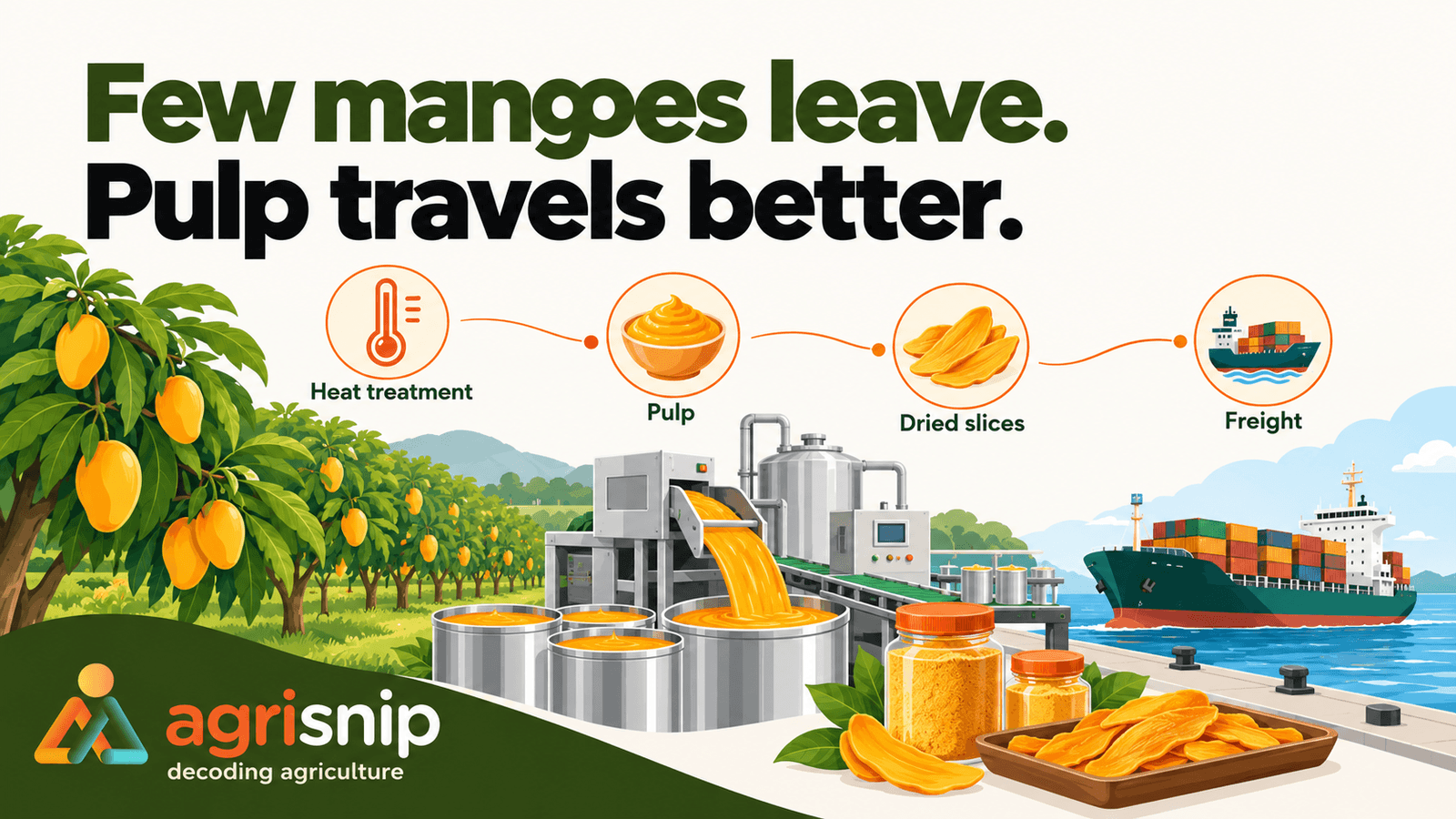
Fresh fruit is the smaller part of the trade. Add pulp, jams, squash, juice and dried products, and India's mango exports were worth between $240 million and $433 million a year from 2014 to 2025. Fresh mangoes brought in about $58 million in 2025. India supplies more than half of the world's mango pulp, and jams, jellies and marmalades were the largest line by value in 2025, at $82 million.
The trade is not steady. Product exports fell from $433 million at the 2022 peak to $240 million in 2025. Yet the authors expect shelf-stable lines to gain, because freight shocks hurt fresh fruit most. Mango powder keeps for 12 to 18 months and needs no refrigerated container. Dried slices are light and suit small processors. Peels, seeds and husks make up 35% to 60% of the fruit's weight, and kernels yield fats used in cosmetics.
One hurdle remains. EU and US rules on biodegradable packaging and labelling cost money, and small units may be priced out without support. For a look at a similar push, read Agrisnip's story on Rajasthan's first guava festival and processing plant.
What It Means for Farmers
For growers of export varieties, Japan's ban removed a premium buyer in a bad year. An Alphonso grower in Ratnagiri told Al Jazeera that Japan paid almost twice what he earned locally.
For most farmers, the bigger point is that fresh export is a narrow door. A pulp, dried or powder unit can take fruit that is sound but not pretty enough to ship fresh. The paper wants Farmer-Producer Organisations (FPOs) and women-led self-help groups strengthened, so small growers can pool fruit, meet export volumes and bargain better. It also asks for bigger budgets for the PM Formalisation of Micro Food Processing Enterprises scheme and the food-processing production-linked incentive scheme, and better use of PM Kisan SAMPADA Yojana funds, where low use has held back outlays.
What Farmers Can Do Now
Nothing here is a new rule, so there is no deadline. But you can get ready. Join your local FPO, or start one with neighbouring growers. Write down every spray and its date. Export buyers ask for it, and the EU checks for residues. Ask your district horticulture office or the nearest APEDA-registered packhouse what grading and treatment your variety needs. And if a processing unit works near you, ask what it pays for fruit that fails fresh-market grade.
Conclusion
Japan's suspension closes one market for one season. The lesson is wider: India's mango trade leans on a few premium buyers and a few treatment plants. Watch two things. Japan sends officers before each season, so the inspection ahead of the 2027 season will show whether the plants have been fixed. And watch whether processing gets the public money the paper asks for, because that decides whether small growers ever share in export prices.