
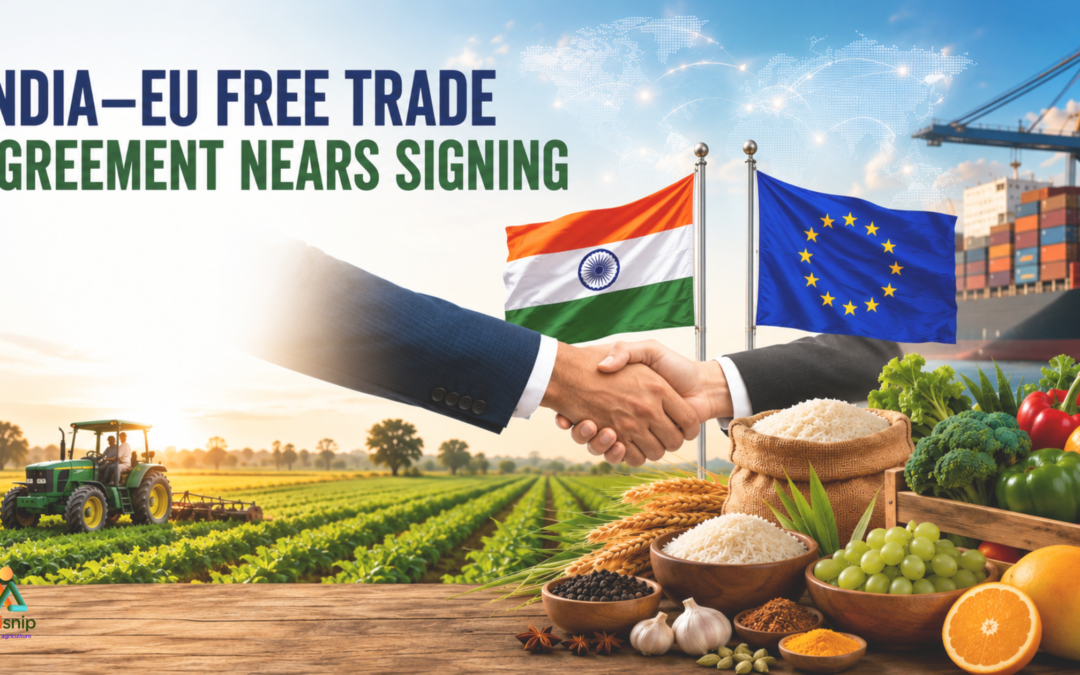
India and the European Union are moving closer to a major trade breakthrough with the proposed Free Trade Agreement (FTA). For Indian agriculture, this could open new opportunities in exports, food processing and value-added products.
But greater access to the European market also means meeting strict standards for quality, safety, traceability and sustainability. The agreement could therefore become an important turning point for Indian farmers and agribusinesses seeking a stronger position in global markets.
A New Chapter in India-EU Trade Relations
The India-European Union Free Trade Agreement (FTA) is moving towards its final signing stage after nearly two decades of negotiations. European Ambassador Hervé Delphin has described the relationship between India and the European as stronger than ever, with both sides adopting a more pragmatic approach to trade and cooperation.
The agreement is particularly important at a time when global trade is facing geopolitical tensions, tariff uncertainties and supply-chain disruptions. India and the EU are also looking beyond traditional trade, with cooperation expanding into clean technology, pharmaceuticals, semiconductors and agri-food value chains.
For India, the FTA is not simply about increasing merchandise exports. It could create a larger and more predictable market for Indian businesses, including agricultural and processed-food exporters. The European market has stringent quality, safety and sustainability requirements, making the agreement an opportunity as well as a challenge for India’s farm economy.
Why Agriculture Could Become a Major Beneficiary
Agriculture could emerge as one of the strategically important areas under stronger India-EU trade relations. Indian exporters have opportunities in products such as processed foods, spices, marine products, fruits, vegetables, organic products and other value-added food categories.
India’s food and beverage exports to the European union were estimated at around $4.2 billion in 2024, indicating that there is already an established trade base that can be expanded. Better market access can help Indian agricultural businesses move beyond exporting raw commodities and focus more on processing, packaging, branding and value addition.
This could create opportunities across the farm-to-market chain, from farmers and aggregators to food processors and exporters. However, European buyers place strong emphasis on traceability, residue limits, food safety and sustainability. Therefore, increased access will benefit Indian agriculture most when farmers and exporters can consistently meet European standards rather than relying only on lower tariffs.
Opportunities and Challenges for Indian Farmers
The FTA can potentially strengthen India’s position in high-value agricultural exports, but its impact on farmers will depend on how effectively market opportunities reach the farm gate. Higher exports of processed agricultural products could increase demand for quality produce and encourage investment in cold chains, storage, grading, packaging and food processing. This could gradually reduce India’s dependence on low-value commodity exports.
At the same time, greater trade integration can expose domestic producers to stronger competition from European agricultural and food products. The European Union’s own agri-food exports to India could also expand as Indian tariffs are reduced under the agreement. The European Commission notes that India’s average tariff on agri-food products is around 36%, with some products facing tariffs as high as 150%.
Therefore, the real agricultural challenge will be maintaining a balance between export opportunities and protection of sensitive domestic segments. Farmer organisations, policymakers and exporters will need to monitor import competition while building India’s competitiveness in products where it has a clear advantage.
From Farm Production to Global Value Chains
The bigger opportunity for Indian agriculture may lie in becoming part of global value chains rather than simply increasing export volumes. The European Union and India are examining cooperation in strategic sectors, including agri-food, with the broader objective of creating stronger and more resilient supply chains.
For Indian agribusinesses, this could encourage investment in food processing, quality certification, logistics, digital traceability and sustainable production. Small farmers could benefit if exporters and food companies build stronger procurement networks and provide access to technology, quality inputs and market information.
However, market access alone will not transform agricultural exports. India will need stronger testing infrastructure, consistent quality standards, efficient logistics and greater awareness among farmers about international market requirements. The FTA should therefore be viewed as a starting point rather than the final destination.
If India can connect its farmers with European demand through better infrastructure, value addition and compliance, the agreement could help Indian agriculture move from being primarily production-driven to becoming more export-oriented and globally integrated.
Read more news articles here : https://agrisnip.com/agri-news/
Conclusion
The India- European Union Free Trade Agreement could mark an important step for India’s agricultural sector, creating opportunities to expand exports, attract investment and promote value-added food products. However, access to the European market will depend on India’s ability to meet strict quality, safety and sustainability standards.
For farmers and agribusinesses, the real opportunity lies in moving beyond raw commodity exports towards processing, branding and global value chains. If supported by better infrastructure, certification and market linkages, the India-European Union Free Trade Agreement could help Indian agriculture become more competitive and globally connected.
