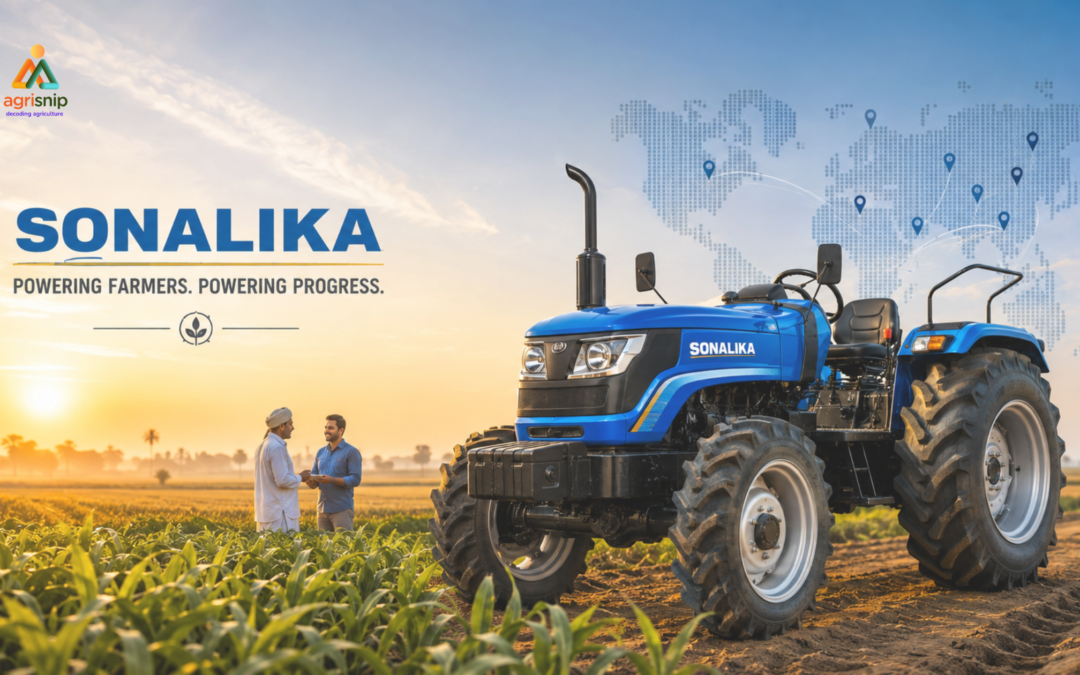
From Hoshiarpur to the World: The Beginning of Sonalika
In 1996, when Sonalika entered tractor manufacturing from Hoshiarpur, Punjab, the Indian tractor market already had established players. Building another tractor company in such a competitive industry was not an easy bet. But founder L.D. Mittal approached the opportunity differently. Instead of treating the tractor as simply a machine, the business focused on a larger question: What does a farmer actually need from mechanisation?
That farmer-first thinking became the foundation of Sonalika’s growth. The company started by understanding agricultural requirements and gradually developed tractors designed around different soils, crops, applications and regional conditions. What began as an Indian manufacturing venture has now become a global agricultural machinery business. In 2026, Sonalika completed production of its 20 lakhth tractor, a milestone achieved in just 30 years. The company says it now serves more than 19 lakh customers across 150+ countries and has an annual production capacity of 300,000 tractors.
The First Lesson: Build for Farmers, Not Just for the Market
The most important part of Sonalika’s strategy was understanding that agriculture is not a uniform business. A tractor that works perfectly for one farmer may not be ideal for another because farming conditions differ dramatically. Soil type, landholding, crops, implements, terrain and labour availability all influence machinery requirements.
Sonalika therefore built a wide portfolio instead of depending on a single standard tractor configuration. The company currently offers tractors across a broad horsepower range and highlights customised products for different markets. Its international strategy under the SOLIS brand similarly involved studying local agricultural practices and adapting products to regional requirements. Sonalika’s official account describes this approach as developing products suited to different soils, states and applications.
For agribusinesses, this is an important lesson: customer segmentation is not limited to marketing. It can shape the product itself. Sonalika converted differences between farmers into an opportunity for product differentiation.
Manufacturing Became a Competitive Advantage
Once product customisation became central to the business, manufacturing capability became equally important. Sonalika invested heavily in its integrated manufacturing facility at Hoshiarpur, Punjab. The company states that the plant has an annual production capacity of 300,000 tractors and supports its large product portfolio.
This vertical integration gave Sonalika greater control over engineering, quality, production and product development. Instead of depending heavily on outside suppliers for every major component, the company built substantial in-house capabilities.
The strategic advantage is significant. In agricultural machinery, reliability matters because a machine breakdown during sowing or harvesting can affect the economics of an entire crop cycle. Manufacturing control therefore becomes more than an operational advantage—it becomes part of the customer value proposition. Sonalika’s journey demonstrates how scale, engineering and farmer-centric product development can reinforce one another.
Customisation Became the Engine of Global Expansion
Sonalika’s international growth is perhaps the most interesting part of its story. Rather than assuming that an Indian tractor could simply be exported unchanged, the company focused on understanding different agricultural markets.
Today, Sonalika says it has a presence in more than 150 countries and is India’s No. 1 tractor export brand. It also reports that roughly every third tractor exported from India comes from its Hoshiarpur facility.
This success illustrates an important internationalisation strategy: standardise the core technology, customise the application. The company could use the advantages of large-scale manufacturing while adapting tractors to the requirements of individual markets.
For an agribusiness reader, this is a powerful model. Global expansion does not necessarily mean creating completely different businesses for every country. Instead, companies can build a strong common technological foundation and customise the final solution according to local farming realities.
Exports Were Not Just a Revenue Channel
For Sonalika, exports became more than a way to sell additional tractors. They became a source of market learning. Different countries exposed the company to different farming practices, regulatory requirements and customer expectations.
That international exposure could then strengthen the company’s product-development capabilities. Sonalika says its leadership studied agricultural complexities in different regions and used those insights to influence product customisation. The company also operates under the SOLIS brand internationally.
The strategy created a useful feedback loop:
Global markets → farmer insights → product adaptation → stronger technology → wider market acceptance.
This is one reason Sonalika’s story matters beyond tractors. Agribusiness companies dealing with seeds, irrigation equipment, farm implements or digital agriculture can apply the same principle. International markets should not only be treated as destinations for products; they can also become sources of knowledge and innovation.
Distribution and After-Sales Service Built Farmer Trust
A tractor is not a one-time consumer purchase. Farmers depend on it for years, which makes dealerships, spare parts, servicing and technical support critical to the business model.
Sonalika reports a network of more than 1,000 channel partners, 15,000+ retail points and 375+ stockists. It has also established skill-development centres to train farmers in the use of tractors and implements.
This ecosystem helps address one of the biggest challenges in agricultural machinery: ownership without operational support has limited value.
The company’s approach therefore goes beyond selling horsepower. Training, service and distribution help turn machinery into a usable farm solution. Its later focus on transparency reinforces the same idea. Sonalika says it became the first tractor company in India to publish tractor prices online in 2022 and subsequently published service costs online in 2025.
Trust, therefore, became part of the product.
The Success Strategy Behind Sonalika’s Growth
Sonalika’s growth can be understood through five interconnected strategic decisions. First was farmer-centric product development—building machines around actual agricultural requirements. Second was customisation, allowing the company to serve diverse domestic and international markets. Third was manufacturing scale and vertical integration, which strengthened control over production and quality. Fourth was international expansion, using exports to build a global customer base and gain market knowledge. Fifth was distribution and after-sales support, which helped convert machinery sales into long-term farmer relationships.
The results are substantial. Sonalika says it has consistently crossed one lakh annual tractor sales for nine consecutive years from FY2018 to FY2026, reached an overall annual sales figure of 1,80,504 tractors in FY2026, and achieved its highest-ever overall market share of 15.3% in FY2024.
The broader lesson is clear: Sonalika did not build growth around one product feature. It built an ecosystem around the farmer.
But There Is a Problem: What About Farmers Who Cannot Buy a Tractor?
Sonalika’s success also highlights a larger challenge for Indian agriculture. Mechanisation can improve timeliness, reduce labour dependence and increase operational efficiency, but owning a tractor is not economically sensible for every farmer.
For a smallholder cultivating only a few acres, purchasing a tractor means taking on a large fixed investment. There are also fuel, maintenance, depreciation, insurance and repair costs. If the tractor remains idle for much of the year, the economics of ownership become even weaker.
This is where the future of farm mechanisation may not necessarily be “one farmer, one tractor.” A more inclusive model could be “many farmers, access to one machine.”
Custom Hiring: The Alternative to Tractor Ownership
For farmers who cannot afford a tractor, the strongest alternative is a Custom Hiring Centre (CHC) or local machinery-rental model. Instead of purchasing a tractor, farmers pay for its use when they actually need it—such as for ploughing, sowing, transport or other operations.
India’s Sub-Mission on Agricultural Mechanization (SMAM) specifically promotes Custom Hiring Centres to overcome the economic disadvantage created by small landholdings and the high cost of individual machinery ownership. Current government information says the scheme is designed to extend mechanisation to small and marginal farmers and supports CHCs and Farm Machinery Banks.
This model changes the economics completely. The farmer converts a large capital expense into a variable operating expense.
Instead of asking, “Can I afford a tractor?” the farmer can ask, “Can I afford mechanisation for this particular operation?”
The Future Could Be Shared Mechanisation
Imagine a village where 50 small farmers do not individually own tractors. Instead, an FPO, cooperative, entrepreneur or Custom Hiring Centre owns a fleet of tractors and implements. Farmers book machinery according to their crop calendar and pay only for the hours or acres serviced.
Such a model can increase tractor utilisation while spreading ownership costs across many users. Government programmes already support this broader ecosystem. A recent government update reported that SMAM had supported the establishment of 27,554 Custom Hiring Centres and 25,608 Farm Machinery Banks between 2014–15 and 2025–26.
For rural entrepreneurs, this also creates an agribusiness opportunity: machinery ownership can become a service business rather than merely an equipment purchase.
From Tractor Manufacturer to Agricultural Solution Provider
Sonalika’s own evolution points toward this broader future. Its business now extends beyond tractors into agricultural implements, financing, agri incubation, CSR and farm-to-fork initiatives. The company describes its vision as moving beyond agricultural mechanisation toward becoming a broader agricultural solutions provider.
That shift is important because the next phase of Indian agriculture will not be solved by selling more machines alone. Farmers need access to technology, financing, services, training, implements and markets.
Sonalika’s success story therefore has two sides. On one side, it demonstrates how an Indian manufacturer can build a globally competitive agribusiness through farmer-centric innovation, customisation, manufacturing scale and exports. On the other, the industry’s future must ensure that mechanisation reaches farmers who cannot afford individual ownership.
The Bigger Agribusiness Lesson
Sonalika began with a simple proposition: Indian farmers deserved machinery designed around their realities. Three decades later, that philosophy has helped create a tractor business with a global footprint and a production milestone of 20 lakh tractors.
But the deeper lesson goes beyond the company’s numbers. Successful agribusinesses identify a real constraint—in this case, farm power and mechanisation—and build an ecosystem around solving it.
For large farmers, that solution may be tractor ownership. For smallholders, it may be custom hiring. For FPOs, it could be shared machinery. For rural entrepreneurs, it could become a machinery-as-a-service business.
The future of Indian farm mechanisation will therefore not simply be about how many tractors are sold. It will be about how efficiently farmers can access the right machine at the right time and at the right cost.
That is where Sonalika’s journey offers its most valuable lesson: growth becomes sustainable when technology is built not merely for the market, but around the economics and realities of the farmer.