
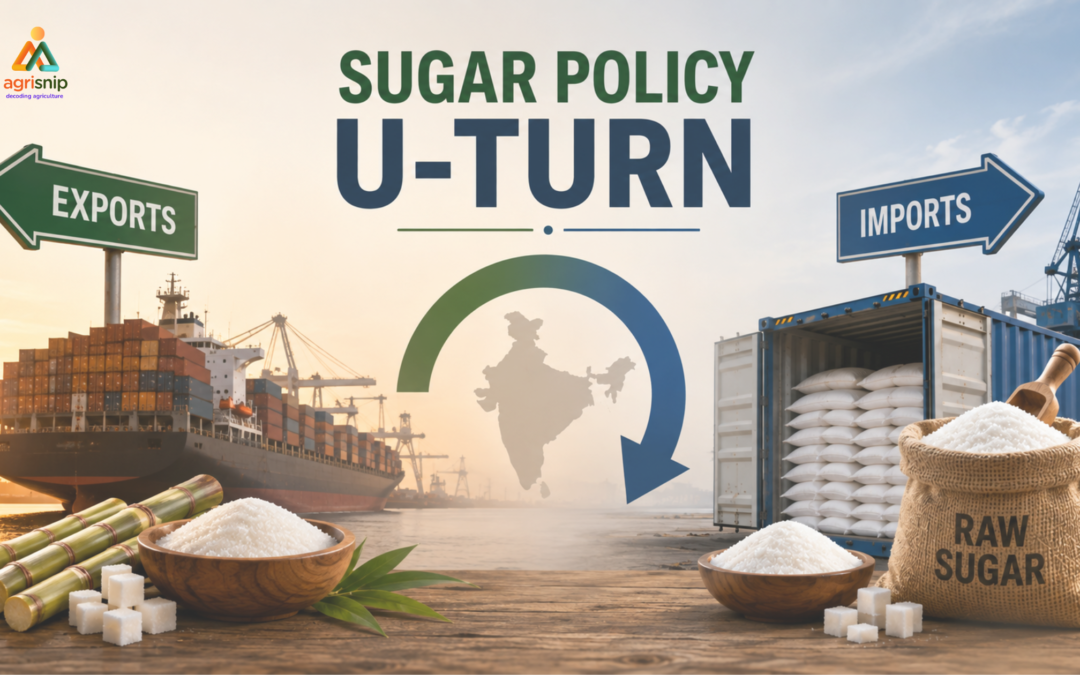
India’s sugar market is witnessing an important policy shift. After allowing sugar mills to export during a period of comfortable domestic availability, the government has now moved towards imports as domestic prices rise and concerns about supplies increase.
This change reflects the complicated nature of India’s sugar economy, where production, consumption, ethanol, weather and government policies are closely connected. Understanding this shift helps explain why India can move from being an exporter to considering imports within a relatively short period.
Why Has India Allowed Sugar Imports?
The government’s decision to permit duty-free imports of one million tonnes of raw sugar is mainly aimed at improving domestic availability before the festive season. Sugar consumption generally increases during festivals because of higher demand for sweets, beverages and processed foods. At the same time, domestic sugar prices have risen sharply, creating concerns for consumers as well as food businesses.
Imports can provide an additional supply buffer when domestic stocks are under pressure. By removing import duties for a limited period, the government can make overseas sugar more competitive in India. The objective is not necessarily to replace domestic production but to prevent a temporary supply shortage from turning into a larger price problem.
From Export Surplus to Supply Concerns
The policy change becomes clearer when viewed against India’s earlier sugar outlook. At the beginning of the 2025-26 season, industry estimates indicated relatively strong production. Based on those expectations, the government permitted sugar mills to export significant quantities. However, production estimates were subsequently revised downward.
Lower production meant that the expected surplus became much smaller. At the same time, domestic consumption continued, while part of the sugarcane supply was directed towards ethanol and other uses. This reduced the amount of sugar available for the domestic market.
This situation demonstrates why agricultural commodity policies cannot always depend on initial production estimates. Weather conditions, crop yields, sugar recovery rates and industrial demand can change the supply situation considerably during a season.
How Production Estimates Affect Policy
Sugar production is not determined simply by the amount of sugarcane harvested. The amount of sugar finally produced depends on several factors, including cane quality, recovery rates and the quantity diverted towards ethanol.
For example, if sugar recovery from cane declines, mills obtain less sugar from the same amount of cane. Similarly, greater diversion of sugarcane or sugar towards ethanol can reduce the quantity available as traditional sugar.
This is why policymakers need a comprehensive sugar balance sheet. Such a balance sheet considers opening stocks, expected production, domestic consumption, exports, imports and ethanol diversion. If any one of these variables changes significantly, the overall supply situation can change.
Weather Is Another Major Factor
Weather uncertainty adds another challenge to India’s sugar industry. Sugarcane requires considerable water, and production can be affected by rainfall patterns, drought-like conditions and other weather disruptions.
Even when early forecasts indicate strong production, later weather developments can affect both cane yields and sugar recovery. This can create a gap between what policymakers expected at the beginning of the season and what is actually available later.
The current situation therefore highlights the importance of regularly updating production estimates instead of relying heavily on early-season projections. More frequent monitoring could help the government identify supply risks before prices increase sharply.
Impact on Consumers and Sugar Mills
For consumers, the import decision could provide some relief if additional supplies reach the domestic market. Greater availability can reduce the pressure that has been pushing prices upward, especially before the festive season.
For sugar mills, however, the impact is more complicated. Higher domestic prices can improve their revenues, but imported sugar may increase competition in the domestic market. Mills also have to balance their sugar production with ethanol opportunities and their financial commitments to sugarcane farmers.
This illustrates the challenge facing the government. A policy that keeps sugar affordable for consumers may not always be equally beneficial for producers. Therefore, sugar policy must balance consumer interests with the financial sustainability of the sugar industry and the income interests of farmers.
Why India Needs Better Supply Monitoring
The biggest lesson from the current policy reversal is the importance of accurate and timely data. India needs a clearer real-time picture of sugar production, stocks, consumption and diversion towards ethanol.
Modern technology could help. Weather information, satellite-based crop monitoring, mill-level production data and inventory information can be combined to create more accurate forecasts. Such systems would allow policymakers to respond earlier to emerging shortages or surpluses.
Better forecasting could also reduce sudden policy changes. Instead of moving quickly from exports to imports after prices rise, the government could adjust trade policies gradually according to changing market conditions.
Conclusion
India’s move from sugar exports towards imports is a reflection of changing domestic supply conditions rather than a simple reversal of policy. Lower production estimates, rising prices, weather uncertainty, domestic consumption and ethanol diversion have all contributed to the changing sugar balance.
The immediate import decision may help strengthen domestic availability ahead of the festive season. However, the long-term solution lies in better forecasting, stronger supply-chain monitoring and more flexible policymaking.
India’s sugar industry is too important to depend only on reactive decisions. Accurate data, timely forecasts and a balanced approach towards farmers, mills, consumers and ethanol producers will be essential for maintaining stability in the sugar market.
