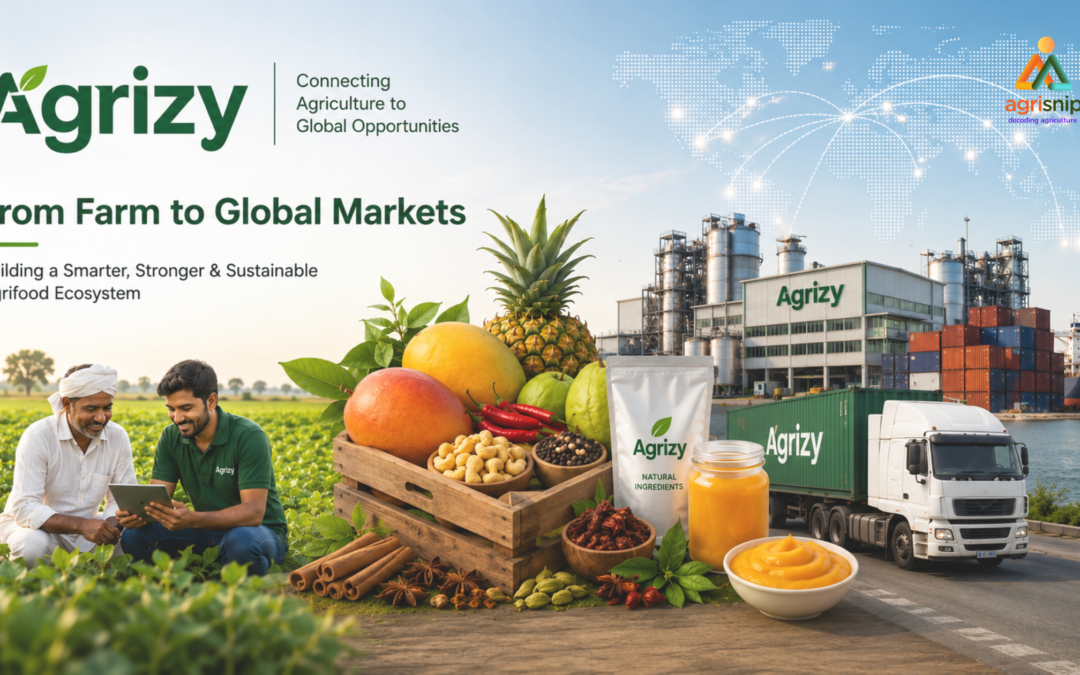
What happens after a farmer harvests a crop? For most, the journey ends at the local market. But Agrizy saw an opportunity beyond the harvest—to connect farmers, processors and global brands through technology and value-added processing. From a young startup in 2021 to an emerging agrifood powerhouse, Agrizy is changing how India’s agricultural products reach the world.
The Problem Hidden After the Harvest
For millions of Indian farmers, harvesting a crop is only the beginning of a much longer journey. Fruits, vegetables, spices, nuts and other agricultural products must travel through several hands before reaching a consumer or a food company. Along the way, farmers can face fragmented markets, processors can struggle with inconsistent supplies, and businesses often find it difficult to source quality agricultural products at scale.
India is one of the world’s largest agricultural producers, yet a significant opportunity lies beyond simply growing more. The real value can come from processing, preservation, quality improvement and connecting Indian produce with larger markets.
This gap between agricultural production and value creation became the opportunity Agrizy decided to pursue. Instead of looking only at the farm, Agrizy looked at what happens after harvest—and began building a business around making that journey more organized, efficient and globally connected.
Where the Agrizy Story Began
Founded in 2021 by Saket Chirania and Vicky Dodani, Agrizy entered the market with an ambitious idea: make India’s fragmented agrifood processing ecosystem more connected and efficient. The founders saw that agricultural businesses often faced challenges not because India lacked produce or processing capacity, but because the different parts of the value chain were not sufficiently connected.
Agrizy therefore developed a B2B platform that connects farmers and farmer producer organizations with processors and, ultimately, brands and buyers. Its focus extends across sourcing, processing, quality management, product development and fulfillment.
The idea was simple but powerful: create one connected ecosystem instead of leaving every participant to navigate the supply chain independently.
From its early-stage beginnings, Agrizy started building relationships across the agricultural ecosystem. What began as a startup addressing supply-chain gaps gradually evolved into a broader agrifood platform with ambitions reaching far beyond India’s domestic market.
From Raw Produce to Value-Added Products
Imagine a mango leaving a farm. At that moment, it is simply a fresh agricultural commodity. But after processing, it can become pulp, concentrate or another ingredient used by food and beverage companies. That transformation is at the heart of Agrizy’s business.
The company works across categories including processed fruits and vegetables, nuts, spices, herbal extracts and wellness ingredients. Instead of treating agricultural produce as a commodity that simply moves from one location to another, Agrizy focuses on increasing its value through processing and organized supply chains.
This approach also addresses one of agriculture’s biggest challenges: perishability. Fresh produce has a limited shelf life and can lose value if it cannot reach the market quickly. Processing can extend usability, improve transportation possibilities and open doors to larger markets.
For Agrizy, therefore, processing is not just another step in the supply chain. It is an opportunity to convert agricultural abundance into higher-value products that can serve both Indian and international businesses.
Building a Bridge Between Farmers and Global Brands
Agriculture has many participants, but they do not always have easy access to one another. A farmer may have quality produce but limited access to organized buyers. A processor may have machinery but struggle to maintain capacity utilization. Meanwhile, a global brand may want Indian ingredients but need consistency, quality and reliable supply.
Agrizy positions itself as the bridge connecting these different needs. Its model brings together sourcing networks, processors and buyers through a B2B ecosystem. According to Agrizy, the company works with 350+ global and domestic brands and exports its products to 20+ countries. This international connection changes the scale of opportunity.
A crop produced in an Indian farming community does not necessarily have to remain a local commodity. Through processing and organized supply chains, it can become an ingredient for a food, beverage or wellness company operating thousands of kilometres away.
That is where Agrizy’s story becomes bigger than a startup story—it becomes a story about connecting Indian agriculture with global demand.
Technology at the Heart of the Supply Chain
Agriculture may begin with soil, seeds and weather, but modern agrifood businesses increasingly depend on technology to coordinate what happens afterward. Agrizy has built technology into its supply-chain operations, supporting areas such as procurement, inventory, payments, fulfillment and order tracking.
The company also works with processors on areas including certification, R&D, technology and market access. This matters because India’s processing ecosystem is highly diverse. Large businesses may have sophisticated systems, while smaller processors can have strong technical capabilities but limited access to customers or markets.
Technology can help connect these capabilities. For Agrizy, the objective is not technology for its own sake. It is technology that makes the agricultural supply chain more visible, organized and scalable.
The bigger ambition is to make it easier for businesses to source the right product, process it to the required specifications and deliver it to the right market.
The Funding That Accelerated the Journey
As Agrizy’s model developed, investors began seeing the potential in its approach to the agrifood value chain. In 2024, Agrizy raised $9.8 million in a Series A funding round, co-led by Accion and Omnivore, with participation from Capria Ventures, Thai Wah Ventures and existing investor Ankur Capital.
The funding represented more than just financial support. It was a signal that investors saw a significant opportunity in India’s evolving agrifood-processing sector. The company had already raised an earlier $4 million seed round in 2022, led by Ankur Capital.
The Series A capital provided Agrizy with the opportunity to expand its products and services and strengthen support for farmer groups and small and medium-sized businesses. For a young startup, this kind of funding can become an important turning point.
It provides resources to move from proving a concept to building a larger platform. Agrizy’s funding journey therefore mirrors its broader story: start small, prove the model, and then build for scale.
From Indian Farms to Global Markets
One of the most compelling parts of Agrizy’s growth story is its international ambition. India has long been a major producer of agricultural commodities. But exporting raw agricultural products is only one part of the opportunity. The bigger opportunity lies in exporting processed, standardized and value-added products.
Agrizy’s reported presence across more than 20 countries demonstrates how an Indian agrifood platform can participate in international supply chains. Think about the journey of a spice, fruit or nut. It may begin with a farmer in an Indian village, move through processing facilities, pass quality checks and eventually become an ingredient in a product sold in another country.
Each stage adds value. This is important for India’s agricultural future because global buyers increasingly look for consistency, traceability, quality and dependable supply.
Agrizy’s model attempts to bring these requirements together while connecting Indian agricultural and processing capabilities with international demand. The ambition is no longer simply to sell what India grows. It is to create higher-value products from what India grows—and sell them to the world.
Creating Impact Across the Agricultural Ecosystem
Growth for an agritech company cannot be measured only through funding or revenue. The bigger question is whether the business is improving the ecosystem around it. Agrizy says it has supported 17,000+ farmers through procurement, training and on-ground initiatives.
It also reports significant processing volumes across its network. The potential impact extends across multiple layers. Farmers and FPOs can gain access to organized procurement channels. Processors can gain access to customers and markets.
Brands can benefit from more structured sourcing. And agricultural products can receive additional value through processing. This creates a network effect: when one part of the ecosystem becomes stronger, other participants can benefit as well.
For farmers, the goal is not simply to produce more. Better market access and value addition can be equally important. For processors, the opportunity is to utilize capacity more efficiently.
For brands, it is about receiving reliable ingredients. Agrizy’s growth therefore reflects a broader idea in modern agribusiness: agricultural transformation happens when the entire value chain becomes stronger, not just the farm.
What Makes Agrizy Different?
The Indian agritech ecosystem is crowded with startups working in areas such as farm inputs, advisory, machinery, finance and marketplaces. Agrizy occupies a somewhat different position. Its central focus is the agrifood processing and B2B supply-chain ecosystem.
Rather than concentrating on a single agricultural product or service, the company works across multiple stages—from sourcing and processing to quality management and market access. This makes its business model particularly interesting because it addresses several problems simultaneously.
A food brand does not simply need agricultural produce. It needs the right quality, quantity, processing specifications, documentation and delivery. Similarly, processors need reliable raw materials and customers who can purchase their output.
Agrizy’s role is to bring these requirements together. Its stated vision of building India into a global agrifood and wellness processing hub reflects this broader ambition. That is perhaps what makes Agrizy’s story distinctive. It is not trying to change agriculture with a single product. It is trying to connect the pieces that make agriculture commercially valuable.
The Road Ahead: Building India’s Agrifood Future
Agrizy’s journey is still unfolding. Founded in 2021, the company has moved from an early-stage idea to a growing platform reporting hundreds of brand relationships, international markets and thousands of farmers supported. But its larger opportunity goes beyond the company’s own growth.
India produces enormous quantities of agricultural commodities. The next chapter of agricultural growth may depend on how effectively the country can process, preserve, package and export these products as higher-value goods.
That creates a huge opportunity for companies operating between the farm and the final consumer. Agrizy is betting on this future. Its story reminds us that agricultural innovation does not always happen in the field. Sometimes, it happens in the processing facility, the supply-chain network, the quality laboratory or the technology platform connecting a farmer to a global buyer.
The journey that begins with a crop does not end at harvest. For Agrizy, harvest is where the real journey begins. And if India’s next agricultural revolution is about moving from being a major producer to becoming a major value-added agrifood powerhouse, Agrizy is positioning itself to be part of that transformation.
Read more successfull agri stories here : https://agrisnip.com/startoscope/
Conclusion: From Harvest to Global Value
Agrizy’s journey reflects a larger transformation taking place in Indian agriculture. By connecting farmers, processors and global brands, the company is addressing one of the most important gaps in the agricultural value chain—turning raw produce into high-value, market-ready products.
From its beginning in 2021 to expanding its presence across international markets, Agrizy has demonstrated how technology, processing and organized supply chains can work together to create new opportunities. Its growth is not just about building a successful startup; it is about showing how India can move from being a major agricultural producer to becoming a global hub for value-added agrifood products.
The story of Agrizy reminds us that the future of agriculture is not limited to what happens before harvest. Sometimes, the biggest opportunity begins after the crop leaves the farm.